
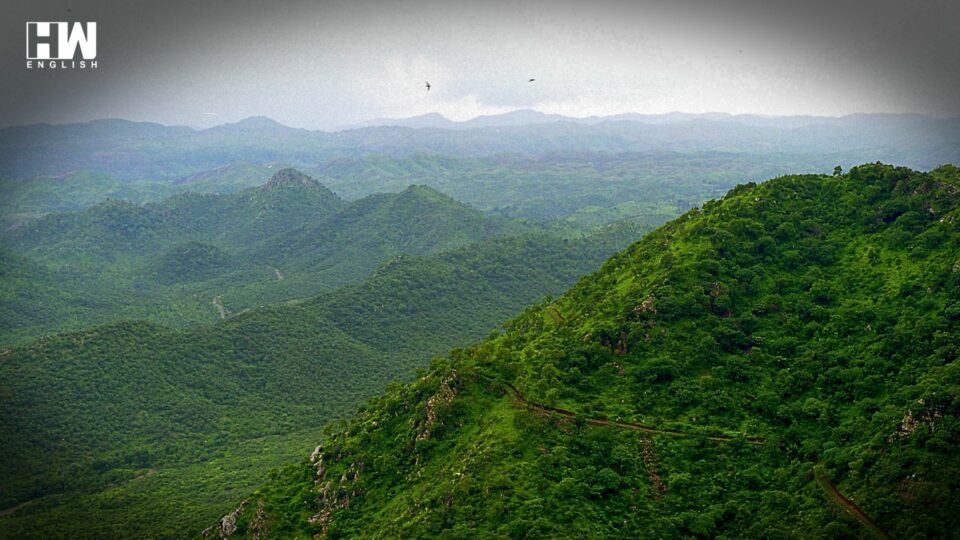
A three billion year old mountain range did not collapse. It did not erode overnight. It was erased quietly. On paper.
The Aravalli Mountains, among the oldest geological formations on Earth, have effectively lost their legal identity. Not because nature failed, but because a definition changed.
In November 2025, the Supreme Court of India adopted a “uniform” legal definition of what qualifies as a hill. Earlier, landforms rising around 30 metres qualified as hills and were protected under various regional standards. Under the new rule, a hill must rise at least 100 metres.
This was presented as administrative clarity. In reality, it became a geological erasure.
The Aravallis are ancient, worn down by time itself. Most stand between 80 and 90 metres high. Under the new definition, they are no longer hills in the eyes of the law.
The numbers are devastating. According to data from the Forest Survey of India, in Rajasthan alone, only 148 out of 1,281 identified Aravalli features meet the new threshold. Nearly 91 percent lost their protected status overnight.
While there is a temporary pause on fresh mining leases until a “Management Plan for Sustainable Mining” is prepared. But the damage is already embedded in law. Once land stops being classified as a hill or protected terrain, environmental clearances stop being safeguards and start becoming procedures. Ecosystems that took millions of years to form can be dismantled in years.
What makes this story more unsettling is this:
The 100 metre benchmark did not emerge accidentally. It was recommended by the Union Ministry of Environment itself, in the name of administrative uniformity. Instead of placing ecological evidence before the court to protect a naturally eroded but continuous mountain system, the state offered the very framework that stripped it of protection. Why? Wasn’t the government aware of the possible consequences. Or, was the decision deliberate?.
And why does this matter to you?
Because the Aravallis are not just rocks and ridges. They are a living shield. They slow the advance of the Thar Desert. They recharge groundwater in some of India’s most water stressed regions. They influence wind patterns and air quality across Delhi NCR. They hold together fragile ecosystems that cannot be recreated once destroyed.
Forests can be replanted. Rivers can be cleaned. A mountain range, once mined and flattened, is gone forever.
As an independent media platform, we do not take advertisements from governments and corporate houses. It is you, our readers, who have supported us on our journey to do honest and unbiased journalism. Please contribute, so that we can continue to do the same in future.
