
It appears that whenever India moves closer to the United States, China takes a step back and whenever India distances itself from Washington, Beijing extends a hand to warm ties with its southern neighbor. This pattern seems to have repeated itself once again when China has claimed that Arunachal Pradesh is a part of China
October 23, 2024 marked an important moment when two Asian giants, India and China, met in Kazan, Russia on the sidelines of the BRICS Summit, initiating fresh talks on de-escalation at the Galwan border, a clash that began in 2020. It was also the first meeting between Prime Minister Narendra Modi and Chinese President Xi Jinping after the Galwan incident, where both leaders agreed to set an ‘early date’ for talks between their top officials to resolve the outstanding issues.
Met President Xi Jinping on the sidelines of the Kazan BRICS Summit.
India-China relations are important for the people of our countries, and for regional and global peace and stability.
Mutual trust, mutual respect and mutual sensitivity will guide bilateral relations. pic.twitter.com/tXfudhAU4b
— Narendra Modi (@narendramodi) October 23, 2024
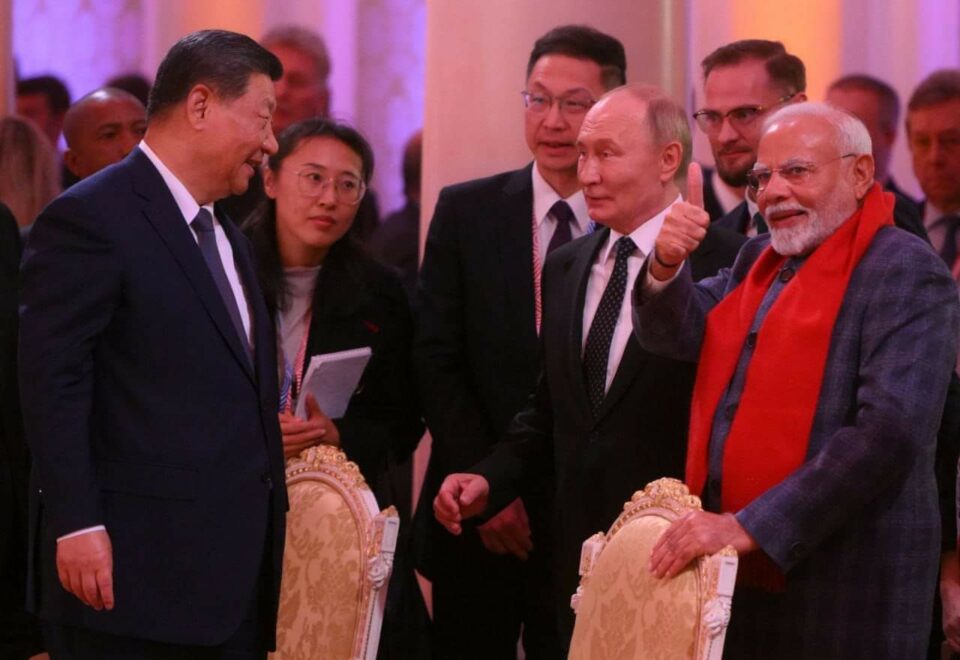
Once strong adversaries, partly due to India’s growing alignment with the United States; India and China appeared to warm up to each other after the BRICS Summit in Kazan. Images of Prime Minister Narendra Modi, Chinese President Xi Jinping, and Russian President Vladimir Putin sharing warm smiles in a single frame dominated newspapers and likely irked the United States as well.
Then, on April 22, 2025, India suffered a deadly cross-border terror attack in Pahalgam. The terrorists came from Pakistan and shot Hindu tourists in the meadows of Baisaran, after which India launched Operation Sindoor, during which the Indian Air Force struck several terror outfits in Pakistan as well as multiple Pakistani airbases.
Incidentally, during the four-day conflict with Pakistan, India’s northern neighbor, China, sided with Pakistan, and most of the military equipment used by the Pakistani side was Chinese, along with some Turkish and American equipment.
India was highly irked with China this time, and Lt. General Rahul R. Singh, Deputy Chief of Army Staff (Capability Development and Sustenance), stated that China had provided Pakistan with live inputs on Indian positions during Operation Sindoor. Explaining Pakistan’s heavy military dependence on China, he further said that Pakistan was “the front face,” while the Chinese provided “all possible support,” which was “no surprise,” given that statistics from the last five years show that 81% of Pakistan’s military hardware is of Chinese origin.
All the progress that India and China had made in improving ties after the BRICS Summit in Kazan came to a standstill, until Trump used his trump card: tariffs against both friends and foes to “Make America Great Again.” The biggest recipients of Trump’s tariff wrath were India and China, which forced both nations to once again hold hands at the Shanghai Cooperation Summit held in Tianjin. This recovery in India-China ties happened so quickly that it almost seemed as if nothing had occurred between the two countries, despite the fact that they were at odds with each other just days earlier. At SCO, the heads of state of Russia, India, and China, i.e. Putin, Modi, and Xi, shared the stage once again. This reportedly irked Trump, who said on Truth Social, “Looks like we’ve lost India and Russia to deepest, darkest China. May they have a long and prosperous future together! President Donald J. Trump.” The SCO Summit reignited the narrative of a Russia-India-China driven world order.
JUST IN: 🇷🇺🇨🇳🇮🇳 President Putin, PM Modi, and President Xi Jinping seen chatting laughing together at SCO Summit. pic.twitter.com/QNK03ilhwv
— BRICS News (@BRICSinfo) September 1, 2025
Public opinion in China also appeared to be strongly pro-India, as reflected in the op-eds published by the Global Times, the flagship newspaper of the Chinese Communist Party. A notable caricature was shared by Yu Jing, the Spokesperson of the Chinese Embassy in India, depicting an elephant representing India and a dragon representing China standing on the Earth with their national flags, shaking hands.
Share with you an article @globaltimesnews. Western media create narrative of “who will replace whom” between #China and #India, which has little substantive value. In today’s complex landscape, it makes far more sense for both nations to deepen trust, manage disagreements,… pic.twitter.com/W0CUcX9FRL
— Yu Jing (@ChinaSpox_India) August 7, 2025
Embracing the spirit of improved India-China ties, Yu Jing also shared a message that read: “Share with you an article @globaltimesnews. Western media create narrative of “who will replace whom” between #China and #India, which has little substantive value. In today’s complex landscape, it makes far more sense for both nations to deepen trust, manage disagreements, foster consensus, widen cooperation, and promote peace in Asia and globally.” She also shared a Global Times article along with the post.
Public opinion in India also turned strongly anti-US after President Donald Trump repeatedly claimed that he had mediated the India-Pakistan ceasefire, even as India consistently rebutted his statements, insisting that the US had no role in the agreement. Rising US tariffs further added fuel to the fire, and the RIC (Russia-India-China) world order began to dominate public discourse in India.
India and China were accused of buying Russian oil and thereby funding Russia’s invasion of Ukraine, something Trump repeatedly urged both countries to stop. Their purchases are expected to drop significantly after the U.S. imposed sanctions on Russia’s two major oil companies, Rosneft and Lukoil. Meanwhile, India and the US also signed a 10-year U.S.–India Defense Framework on the sidelines of the ASEAN–India Defence Ministers’ Informal Meeting in Kuala Lumpur.
I just met with @rajnathsingh to sign a 10-year U.S.-India Defense Framework.
This advances our defense partnership, a cornerstone for regional stability and deterrence.
We’re enhancing our coordination, info sharing, and tech cooperation. Our defense ties have never been… pic.twitter.com/hPmkZdMDv2
— Secretary of War Pete Hegseth (@SecWar) October 31, 2025
Trump and Xi also later met in South Korea, where they agreed that China would ease its export restrictions on rare earth metals to the U.S., and the U.S. would reduce its tariffs on Chinese goods. Several other, less significant agreements were also reached.
India also signed a one-year deal to purchase 2.2 MTPA of LPG, roughly 10% of the country’s annual imports. It is additionally buying American artillery munitions and an anti-tank missile system worth $93 million. Along with that, India has signed a deal to buy 113 jet engines from the U.S. India’s crude oil imports from the U.S. have also risen to a record high since 2022.
It appears that whenever India moves closer to the United States, China takes a step back and whenever India distances itself from Washington, Beijing extends a hand to warm ties with its southern neighbor. This pattern seems to have repeated itself once again when China has claimed that Arunachal Pradesh is a part of China.
An Indian woman from Arunachal Pradesh, Prema Wangjom Thongdok, an Indian financial advisor residing in the UK, claimed that she was harassed at the Shanghai airport after Chinese officials refused to recognize her passport and declared it ‘invalid’ because it listed Arunachal Pradesh as her birthplace.
Responding to this ordeal, the Chinese Foreign Ministry spokesperson Mao Ning said that the woman was not subjected to any compulsory measures, detention, or harassment. Mao referred to Arunachal Pradesh by its Chinese name and asserted that the region belongs to China, reiterating that China has never acknowledged the ‘so-called Arunachal Pradesh’ established by India.
In the case of a woman from Arunachal Pradesh transiting in China, Spox of the Ministry of Foreign Affairs of China, Mao Ning, says, “Zangnan is China’s territory. The Chinese side has never recognised the so-called “Arunachal Pradesh” illegally set up by India. On the individual… pic.twitter.com/UH3cDEV9Kw
— ANI (@ANI) November 25, 2025
She stated: ‘We learned that China’s border inspection authorities went through the entire process according to laws and regulations and fully protected the lawful rights and interests of the person concerned. Zangnan is China’s territory. China has never acknowledged the so-called Arunachal Pradesh illegally set up by India.’
The Indian Ministry of External Affairs spokesperson Randhir Jaiswal responded to the Chinese Foreign Ministry spokesperson Mao Ning saying, “That Arunachal Pradesh is an integral and inalienable part of India, is a self-evident fact. No amount of denial by the Chinese side is going to change this indisputable reality.” Again, at a weekly press briefing Jaiswal emphasized, “China should very well know that its action do not help the relations between the two countries. We have already said that Arunachal Pradesh is an integral and inalienable part of India. The ground reality does not change at all by their actions, and China should know that,”
Our response to media queries on statements made by the Chinese Foreign Ministry⬇️
🔗 https://t.co/3JUnXjIBLc pic.twitter.com/DjEdy7TmTK— Randhir Jaiswal (@MEAIndia) November 25, 2025
India-China ties once again appear to have entered a cold phase after New Delhi’s recent defence and energy deals with the United States. An India–US trade agreement is also on the horizon, which may further determine the trajectory of India’s relationship with its northern neighbour. The looming question of the Dalai Lama’s succession, historically a flashpoint in India-China relations ever since his arrival in India, could trigger another round of strong reactions from Beijing. Ultimately, a familiar pattern seems to be repeating itself: whenever India moves closer to Washington, China takes a step back, and whenever New Delhi steps away from the US, Beijing leans in. China’s renewed claim over Arunachal Pradesh signals that this cycle has once again come full circle. To envisage a good India-China future, a sour India-US relationship is a must.
As an independent media platform, we do not take advertisements from governments and corporate houses. It is you, our readers, who have supported us on our journey to do honest and unbiased journalism. Please contribute, so that we can continue to do the same in future.
