
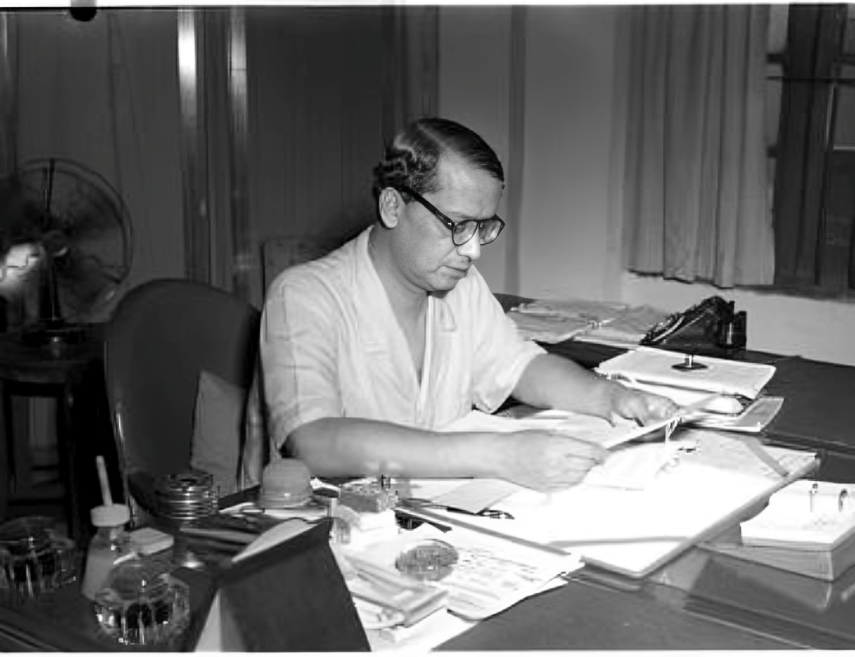
Most Indians have probably never heard of Sukumar Sen.
They should have.
Sen was India’s first Chief Election Commissioner. Appointed in 1950, he was the man entrusted with one of the most extraordinary administrative exercises in modern history: creating India’s first electoral rolls and conducting its first general election.
Think about the India he was working in.
There was almost no technology. No computers. No Aadhaar. No mobile phones. No digital databases.
India had just emerged from Partition. The population was around 36.5 crore and literacy was only 16.6 percent. Yet the Election Commission had identified and enrolled more than 17.3 crore voters for the first general election.
People physically went out, village by village, locality by locality, often door to door, to find citizens and put their names on the electoral roll.
And here is something remarkable.
The central instinct was inclusion. Not deletion.
Find the citizen.
Register the citizen.
Give the citizen a place in India’s new democracy.
Even when social customs prevented many women from giving their own names, Sukumar Sen insisted that women should be registered in their own names rather than as somebody’s wife or somebody’s mother. The Election Commission records that large numbers of such entries had to be corrected. 
This was the spirit in which India built its democracy.
Nehru, Ambedkar, Rajendra Prasad and the Constituent Assembly created the constitutional foundation for universal adult suffrage. Sukumar Sen and the Election Commission turned that promise into an electoral system that could actually work on the ground.
And that achievement deserves perspective.
The first Indian general election was the largest democratic exercise the world had seen, conducted through universal adult suffrage in a country that was poor, overwhelmingly rural and overwhelmingly illiterate. 
So the next time someone asks, “What did Nehru do for India?”, remember this.
The founding generation did something extraordinary.
They did not inherit a functioning democracy.
They built one.
They understood that democracy begins not with the politician.
It begins with the voter.
As an independent media platform, we do not take advertisements from governments and corporate houses. It is you, our readers, who have supported us on our journey to do honest and unbiased journalism. Please contribute, so that we can continue to do the same in future.
