
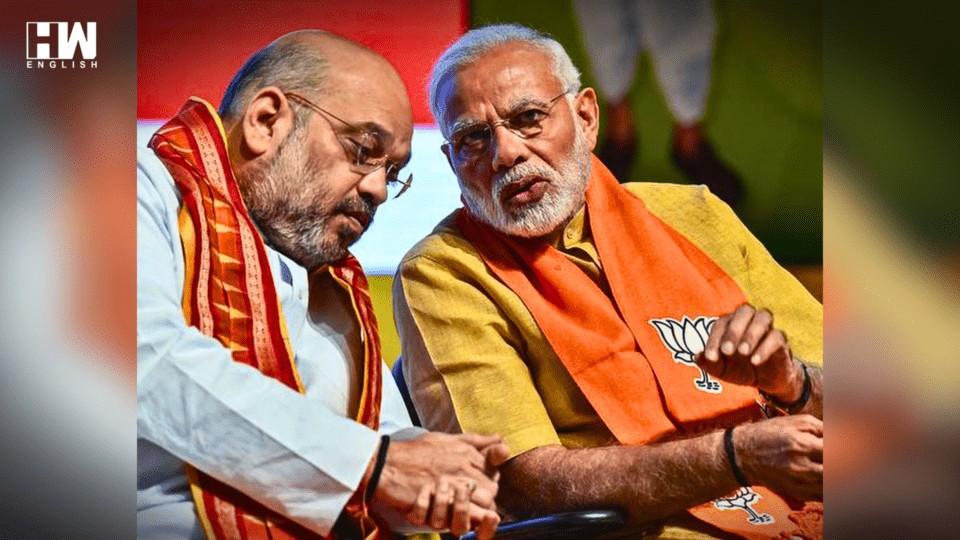
Jawaharlal Nehru University has announced that it will take the strictest action against students who raised slogans against the Prime Minister and the Home Minister. The administration says freedom of speech is important, but campuses must remain spaces of learning and not laboratories of hate. It has also warned that any activity seen as undermining national unity will not be tolerated.
This raises a fundamental question. When does dissent become hate?
Indiscipline, violence, or intimidation have no place in any educational institution. That is beyond debate. But peaceful dissent is not indiscipline. It is not hatred. Questioning authority, questioning power, and questioning ideas are among the most basic lessons a democracy is meant to teach its young citizens.
A fair counter argument must also be acknowledged. There is a line between dissent and hate, and that line is crossed when slogans like “Modi-Shah ki kabr khudegi” (Modi and Shah’s graves will be dug). move away from opposing policies or ideology and begin targeting an individual with language that calls for harm or death. That concern cannot be dismissed outright. However, this is precisely where the question of selective enforcement becomes unavoidable. If similar or even harsher slogans have been raised on campuses by other groups in the past without FIRs or threats of expulsion, then the claim of acting purely to protect national unity begins to look less like a principled stand and more like political bias. Consistency is the true test of intent. Without it, discipline appears selective and authority starts to look partisan rather than institutional.
If every college, university, and educational institution decides that students cannot raise slogans or express opposition against the Prime Minister or the Home Minister, what are we really teaching them? That right and wrong do not matter. That power is above scrutiny. That some individuals are beyond questioning.
And then, in the very next breath, we claim to be a democracy.
Why has freedom of expression suddenly become such a contested idea? Why do we keep redefining it depending on who is being questioned? Anything expressed peacefully, without violence, remains legitimate speech in a democratic society.
History offers useful perspective.
Jawaharlal Nehru University has seen slogans and protests against governments across decades. Indira Gandhi faced sloganeering on this very campus. Her entry was once blocked. Yet it was not branded as anti national activity. Students were not treated as enemies of the state. Manmohan Singh too witnessed sharp criticism during his tenure. Democracy survived. India moved forward.
So what has changed now?
Even if students question the foundations of our country or our society, the responsibility lies with us, as leaders, teachers, and parents, to engage with them. To explain. To convince. To help them understand the idea of India better. Threatening them for thinking differently does not strengthen the nation.
These students are our children. Filing FIRs against them is not a solution. Fear has never produced conviction. Dialogue does. Explaining with patience, love, and affection, and trying to persuade rather than punish, is how young minds are shaped and how societies mature.
Non violent protest is not a threat to democracy. It is its safety valve. Teaching students to raise their voice peacefully and stand up for what they believe is not weakening India. It is reinforcing democratic values.
In a democracy, the duty of a leader is to explain policies and justify decisions, not to ban questions or silence criticism.
I honestly wonder what is changing in India today.
Is it our understanding of freedom?
Or is it our understanding of democracy itself?
Because when questioning those in power begins to look unacceptable, we must admit that something far deeper is being redefined.
Dear Readers,
As an independent media platform, we do not take advertisements from governments and corporate houses. It is you, our readers, who have supported us on our journey to do honest and unbiased journalism. Please contribute, so that we can continue to do the same in future.
As an independent media platform, we do not take advertisements from governments and corporate houses. It is you, our readers, who have supported us on our journey to do honest and unbiased journalism. Please contribute, so that we can continue to do the same in future.
