
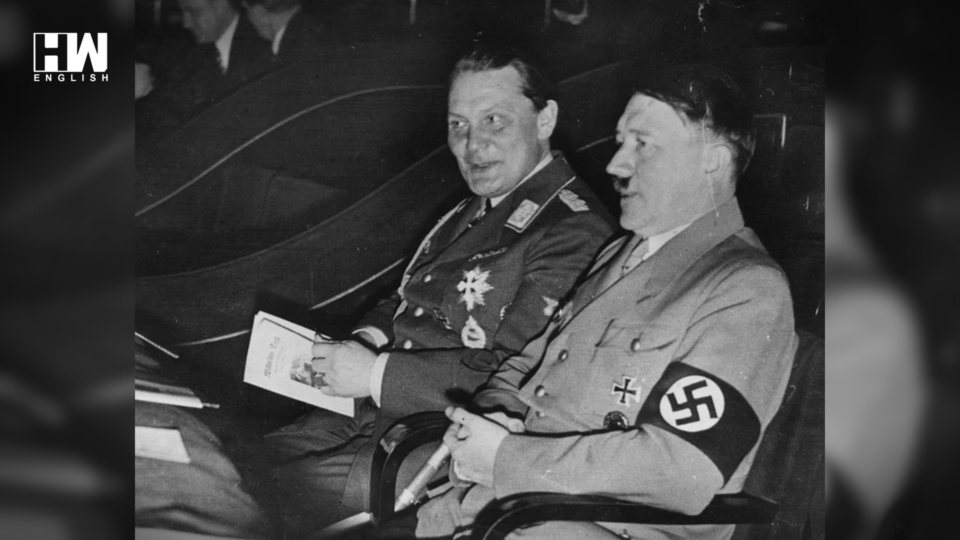
Goering’s defence was ultimately a defence of his own identity and a rationalisation of the crimes committed by those he considered his own. We see similar patterns both within our republic and outside where atrocities are excused, minimised or ignored not because they are unknown but because they are committed against those who fall outside the imagined circle of “us.”
Hermann Goering, the Reichsmarschall of Nazi Germany and Adolf Hitler’s designated successor, was tried for war crimes and crimes against humanity after World War II. He appeared before the International Military Tribunal at Nuremberg, Germany. Goering was the highest-ranking Nazi leader captured alive by the Allied powers; many others had either been killed, disappeared or committed suicide. Along with 22 other prominent Nazi officials subordinate to him, Goering was to face the trial for the crimes he committed. While being tried at Nuremberg, he was detained at Bad Mondorf in Luxembourg, in a large hotel that had been converted into a prison to keep the senior Nazi officers.
The Reichsmarschall was accompanied by a psychiatrist named Douglas M. Kelley, who initially served as a U.S. Army Major and was later appointed chief psychiatrist to assess the mental condition of the Nazi prisoners. Though Goering was a prisoner, Kelly and Goering developed a special relationship and both held several hours of conversation inside the gallows. “They weren’t buddies – but they formed a connection, and Kelley recognised that they shared certain personality traits”, the American author and journalist Jack El-Hai told the BBC.
Kelley asked Goering what he and many other Germans admired so much about Hitler, given that he had been a failed painter and not a very successful soldier. “He made us feel German again,” said the Reichsmarschall. He expressed his unwavering affection for the Führer by recounting an incident from 1922, when he first saw Hitler speaking in a coffee shop to about thirty people. At a time when Germany was crushed under the Treaty of Versailles, Goering remembered Hitler declaring, “French bellies are being filled with German pain. If you make threats, you need bayonets. Rearm. Down with Versailles.” That night, Goring said, he became a National Socialist.
From then on, he no longer saw Hitler as merely a personality but as an ideology, an ideology he believed in, one to which he devoted his entire life and one he would never abandon, not even at the cost of his own life. And Kelly understood this.
Following this exchange, Goering walked towards his fate in the courtroom, where he was confronted with the full might of his evil deeds that he and his mates had committed while they ruled their empire. Before the tribunal, he was to answer for the brutal war crimes carried out by the Nazi regime against its adversaries and above all, for the monstrous crimes against humanity inflicted by them upon its own Jewish citizens. He perhaps realised that history would never be kind to him or his brethren. He was questioned about the overthrow of the Weimar Republic by the Nazis, the abolition of parliamentary democracy, the suppression of political and civilian opposition, the occupation of Austria, Czechoslovakia, Poland and above all, the elephant in the room: the extermination of the Jewish population. Goering attempted to justify the overthrow of the Weimar Republic and the suppression of opposition saying that people had given them the mandate for change but he evaded the question of the Jewish Holocaust by claiming he was unaware of the killings in the concentration camps. Justice Jackson, who was interrogating the Reichsmarschall, presented a signed letter in court, ratified by Goering and argued that it proved that Goering knew about the killings. Goering denied this, insisting that the letter Jackson referred to did not concern the extermination of Jews but rather their emigration and claimed that Jackson had mistranslated its contents.
Conceding that Goering may not have known of the killings at first, the truth eventually stood before him, the extermination of millions in the camps. And when he was asked whether he still stood with the Führer, Adolf Hitler, his answer was chillingly unwavering: “Yes.” Then, with cold resolve, he added, “Heil Hitler.” The commitment, Kelly knew, that he would never break and which he also told the prosecutor about. He didn’t justify or evade the crimes that his leader committed, like he did previously but he rationalised it with a “yes” and he emphasised that he does stand with his commander irrespective of what he has done.
Goering could perhaps have evaded the noose had he not expressed his unconditional support for Hitler but he did. He supported Hitler not out of fear but out of belief. To turn against the Führer would have meant turning against the entire Nazi project, a project that gave him identity. As Goering once told Kelley in prison, “Hitler made me feel German again.”
Thus, even when asked whether he still stood by Hitler despite the murder of six million Jews, Goering rationalised the killings because he continued to believe in Hitler and because going against him would have meant admitting that the entire Nazi project was wrong. An act committed by his leader, one that killed millions of his fellow citizens solely because of their race, was rationalised by Goering in a single sentence: “Yes, I stand by my leader. Heil Hitler.” Betraying Hitler would have stripped Goering of purpose. That is why he did not follow Hitler blindly but believed in him, seeing himself as a co-creator of the Reich. Defending Hitler meant defending himself and praising him became Goering’s final act of dominance.
Goering’s defence was ultimately a defence of his own identity and a rationalisation of the crimes committed by those he considered his own. We see similar patterns both within our republic and outside where atrocities are excused, minimised or ignored not because they are unknown but because they are committed against those who fall outside the imagined circle of “us.” This “us” can be defined by religion, ideology, nationality or any other shared identity. Once drawn, it allows violence against the “other” to be justified or worse, rendered invisible. The person on the receiving end may have done nothing wrong to the collective “us.” Yet, simply because he does not think in a certain way or behave in a certain way, an atrocity is inflicted upon him for a crime he never committed. This is the Hermann Goering that exists within all of us.
When Christmas celebrations are vandalised in India and ignored by certain groups, it is often because the perpetrators belong to the imagined circle of “us.” Similarly, the killings of Hindus in Bangladesh are ignored by some because, once again, the perpetrators are seen as part of that same imagined “us.”
The same logic applies to the genocide of Kashmiri Hindus, the atrocities inflicted upon Muslims and Dalits in parts of India and the persecution of minorities in Pakistan. Just as Jews were excluded from the Nazi imagination of “us”, these communities are often excluded from the collective “us” in our part of the world.
As a result, they suffer while the “us” looks away, yet the same “us” will raise its voice when atrocities are committed by a different collective against those who belong to its own imagined circle. This is our hypocrisy. The question then is whether we truly have the right to condemn a particular atrocity if we have not first ensured that our own backyard is clean? I do not think so.
Either every atrocity shall be condemned and condemned unequivocally, irrespective if the perpetrator belongs from your imagined circle of “us” or one shall not condemn a single atrocity even if the victim belongs to your imagined circle of “us”. A Reichsmarschall Hermann Goering in every imagined circle of “us” would lead the world into chaos, a world where might becomes right and the weak are punished simply for falling outside the umbrella of “us,” for crimes they have never committed.
The atrocities against a Hindu in Bangladesh, Pakistan or Kashmir may be minimised by the majority there, just as atrocities against Muslims, Christians and Dalits are often minimised here in India. The logic is the same, even if the identities change.
Therefore, to every Hindu, Muslim, Sikh, Jain and Buddhist in India and to those in Pakistan and Bangladesh and to everyone who claims to care about justice, the first task must be to look inward and clean one’s own home. It is not wrong to condemn atrocities committed by one’s own brethren. Only then does pointing to atrocities elsewhere, where the victim belongs to one’s imagined circle of “us” carry moral meaning.
That is my submission. Kill the Hermann Goering within you. Goering did not and history judged him accordingly. We however, still stand before an unfinished trial. We can escape our Nuremberg only if we stop defending the indefensible.
As an independent media platform, we do not take advertisements from governments and corporate houses. It is you, our readers, who have supported us on our journey to do honest and unbiased journalism. Please contribute, so that we can continue to do the same in future.
