
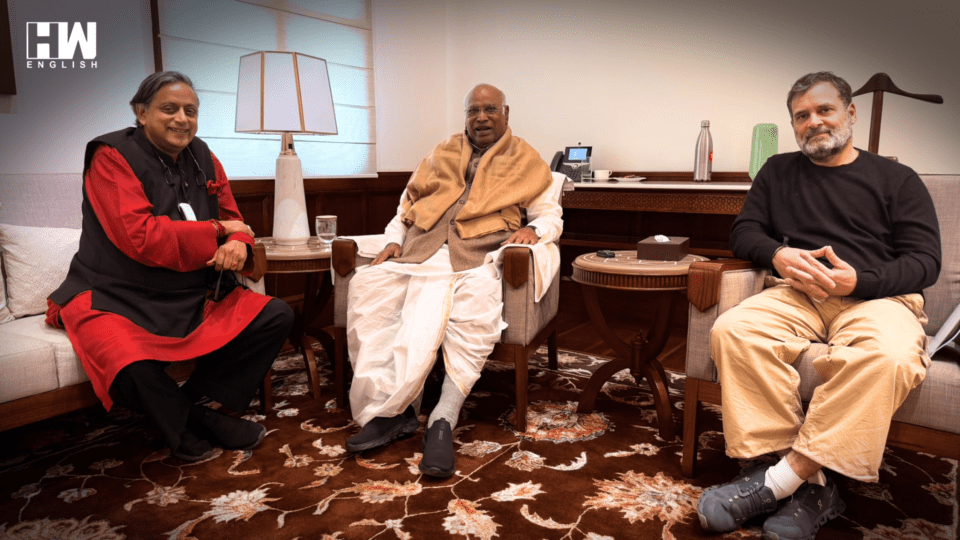
Shashi Tharoor has walked into the office of Rahul Gandhi and Mallikarjun Kharge carrying a peace flag. That act alone raises an obvious question. Why now?
The answer is simple:
The BJP did not reward Tharoor for publicly distancing himself from the Congress, humiliating Rahul Gandhi, or praising Narendra Modi. More importantly, for the BJP, Tharoor brings more risk than value in Kerala. The party already has a far more effective political instrument in the state in the form of Rajeev Chandrasekhar.
Chandrasekhar, who lost narrowly to Tharoor in the 2024 Thiruvananthapuram contest, has since emerged as a relentless organiser. He is visible, combative, and constantly keeps the BJP in the political conversation in Kerala. For the BJP, upsetting a committed and hardworking leader like Chandrasekhar to accommodate Tharoor would make little sense. The choice was clear.
Beyond that, Tharoor does not command a dependable vote bank. He is not a mass leader rooted in the streets and wards. At best, he offers ornamental value. Unlike the Congress, the BJP places little weight on such political equity.
Tharoor was initially romanced. He was sent on global outreach after Operation Sindoor, despite his party’s discomfort. He was selectively amplified to embarrass Rahul Gandhi, especially during Putin’s India visit. And then, once his utility ended, he was quietly benched. Tharoor understood that despite repeatedly wounding the Congress, the BJP saw no long term place for him. That realisation pushed him back, unconditionally, with folded hands.
Why was this disappointing?
Because I always believed Tharoor stood for something firmer. Secularism, liberalism, institutional fairness. He spoke forcefully against Modi on governance and ideology for years. Yet, after being elected again from Thiruvananthapuram on a Congress ticket in 2024, the critic suddenly turned into a statesman. Dissent gave way to admiration almost overnight.
Tharoor lost a Congress presidential election fair and square. Instead of accepting the verdict, he carried the bitterness forward and seemed to derive satisfaction from publicly undercutting his own party and its leadership. It is hard to reconcile this conduct with that of a former UN diplomat who was given political space and legitimacy by the Congress.
Why did the Congress accept him back?
Because Kerala is heading into elections in March or April. The party has far bigger battles to fight. A sulking Member of Parliament at such a moment is a distraction no organisation wants. Tharoor may not be a decisive vote catcher in Kerala, but a disgruntled MP can still create unnecessary turbulence.
Will this peace last?
Unlikely.
A broken mirror can be glued back together, but the cracks never disappear. Trust once damaged does not fully return. Tharoor will continue to look for alternatives. Whether he finds one is an entirely different question
As an independent media platform, we do not take advertisements from governments and corporate houses. It is you, our readers, who have supported us on our journey to do honest and unbiased journalism. Please contribute, so that we can continue to do the same in future.
