
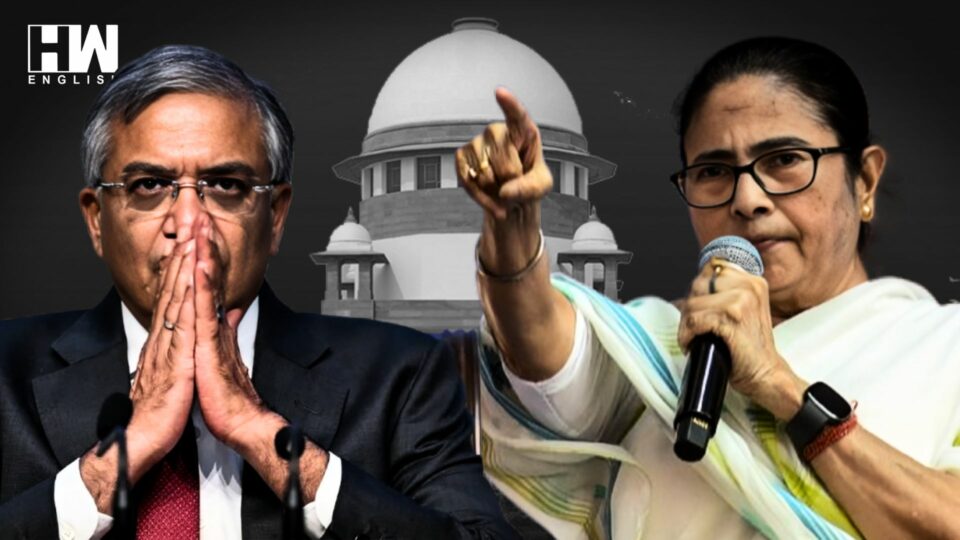
Mamata Banerjee’s strategy may not halt the SIR but could cement her as the indomitable “Didi”
In the lead-up to West Bengal’s 2026 assembly elections, Chief Minister Mamata Banerjee’s fierce opposition to the Election Commission’s Special Intensive Revision (SIR) of electoral rolls has escalated into a high-stakes confrontation, culminating in her unprecedented personal appearance before the Supreme Court.
This exercise, aimed at purifying voter lists by removing duplicates, deceased individuals, and ineligible entries, has instead become a flashpoint for allegations of disenfranchisement and political maneuvering. Banerjee, leader of the Trinamool Congress (TMC), has positioned herself as the guardian of Bengali voters against what she terms a “backdoor” implementation of the National Register of Citizens (NRC), drawing parallels to Assam’s controversial citizenship drive.
With over 58 lakh names deleted from the draft rolls and 1.36 crore voters flagged for “logical discrepancies” via AI-driven scrutiny, the SIR has sparked widespread anxiety, including reported suicides and mass migrations across borders.

Framing SIR as Backdoor NRC
Banerjee’s masterstroke lies in reframing the SIR—a routine electoral hygiene measure—as a sinister plot to erode Bengali identity, particularly among rural and marginalized voters. By labeling it a “backdoor NRC,” she evokes the specter of Assam’s 2019 exercise, where nearly 19 lakh people, including many Hindus and Muslims, were excluded, leading to detention fears and social upheaval.
In West Bengal, where porous borders with Bangladesh have long fueled debates on infiltration, Banerjee argues that the SIR’s demands for legacy linkage to 2002 rolls and progeny mapping disproportionately target women (due to surname changes post-marriage), migrants, and low-income families unable to produce decades-old documents. This narrative resonates deeply in rural Bengal, home to a significant Matua community of Hindu refugees from Bangladesh, who fear revocation of citizenship despite the Citizenship Amendment Act’s promises.
Data underscores the human cost: Notices for hearings have overwhelmed 63 lakh unmapped voters, with queues stretching hours and AI-flagged errors—such as improbable age gaps or household sizes—leading to erroneous deletions. Banerjee’s Supreme Court petition highlights how 18.7 lakh deceased voters remain on rolls while living individuals are marked “dead,” amplifying perceptions of bias. By casting Bengalis as victims of a central government’s overreach, she sparks a sympathy wave, positioning the TMC as the defender of subaltern interests against an allegedly partisan Election Commission.
This tactic mirrors her successful 2021 campaign, where she portrayed federal agencies as tools of the Bharatiya Janata Party (BJP), rallying voters around regional pride. In a state where 70% of the population is rural and literacy rates hover around 77%, such emotive framing mobilizes grassroots support, turning administrative scrutiny into a cultural battleground.

BJP’s Muted Counter
The BJP’s response to Banerjee’s onslaught has been notably restrained, hampered by the sub-judice nature of the Supreme Court proceedings and internal divisions. Central leaders like Union Home Minister Amit Shah have endorsed the SIR as essential for “pure electoral rolls,” emphasizing the removal of 1.2 crore alleged illegal voters to curb infiltration—a key BJP plank in border states. Yet, they have largely avoided direct engagement, citing judicial propriety, leaving state-level figures to recycle familiar accusations of TMC sheltering infiltrators for vote-bank politics.
Here. Mamata’s strategy is that she knows the BJP will not defend the EC as a political party after some time because the party wants to show that the EC is independent.
This silence cedes narrative control to Banerjee, who has amplified her claims through dramatic gestures, including a Delhi press conference with “SIR victims” and poetry collections protesting the exercise. BJP state chief Suvendu Adhikari’s letters to the Chief Election Commissioner dismiss her concerns as “fiction,” but lack the emotional punch of Banerjee’s rhetoric.
The party’s internal analysis shows the SIR has not disproportionately benefited them, as seen in Bihar’s recent polls where similar revisions did not sway outcomes. With the Supreme Court urging the Election Commission to ensure no genuine voter is excluded and questioning the deployment of 8,300 external micro-observers—deemed “unconstitutional” by Banerjee—the BJP risks appearing complicit in a flawed process. This constraint allows TMC to dominate public discourse, portraying the opposition as out of touch with Bengal’s ground realities.
Tangible Voter Impacts
What sets the SIR apart from abstract policy debates is its immediate, visceral impact on everyday lives, fueling mobilization in a state known for its politically charged electorate. Unlike theoretical discussions on federalism or economic reforms, the revision triggers real-world anxieties: fear of disenfranchisement, long queues for hearings, and even tragic outcomes like 28 reported deaths linked to stress, including suicides over document discrepancies. Migrant workers, comprising a significant portion of Bengal’s workforce, face dual jeopardy—rushed trips home to verify details and potential loss of welfare access tied to voter IDs.
Gender bias is stark: Nearly 4 lakh more women than men have been deleted, often due to post-marriage name changes or AI misinterpreting family structures. In border districts, undocumented migrants have fled to Bangladesh, fearing deportation, while communities like the Matuas grapple with legacy proofs amid unnotified NRC linkages.
These lived consequences—errors in translation of old records, rejection of Aadhaar as proof, and “inhumane” pressure on booth-level officers (with 77 deaths reported)—resonate more than policy briefs. In Bengal, where voter turnout exceeds 80% and elections are identity-driven, such tangible threats galvanize support for Banerjee, who has written multiple letters to the Chief Election Commissioner decrying the “chaotic” process. Historical precedents, like the 2009 onwards anti-CPI(M) movements, show how personal grievances amplify political shifts, making SIR a potent mobilizer for TMC.

Diverting from Governance Woes
Banerjee’s SIR offensive shrewdly diverts attention from TMC’s governance lapses, recasting the narrative as a defense of Bengali pride against a hegemonic Centre. Allegations of corruption—teacher recruitment scams, cattle smuggling, and misappropriation of MGNREGA funds totaling over Rs 10 lakh crore—have plagued her regime, with Amit Shah branding it the “most corrupt” in India.
Recent tragedies, like the Anandapur factory fire killing 27, have been attributed to administrative failures and syndicate control. By shifting focus to the SIR as an “assault on democracy,” Banerjee transforms these vulnerabilities into a unifying rallying cry, positioning TMC as the bulwark against BJP’s alleged infiltration agenda.
This template—challenging central authority through courts and streets—bolsters her federalist credentials, appealing to opposition allies in the INDIA bloc while energizing Bengal’s syncretic ethos. As the Supreme Court hearings continue, with directives for careful notices and inclusive proofs, Banerjee’s strategy may not halt the SIR but could cement her as the indomitable “Didi,” turning electoral revision into a referendum on regional autonomy.
Sayantan Ghosh is an academic and the author of ‘The Aam Aadmi Party: The Untold Story of a Political Uprising and Its Undoing’. He is on X as @sayantan_gh. Views expressed are personal.
As an independent media platform, we do not take advertisements from governments and corporate houses. It is you, our readers, who have supported us on our journey to do honest and unbiased journalism. Please contribute, so that we can continue to do the same in future.
