
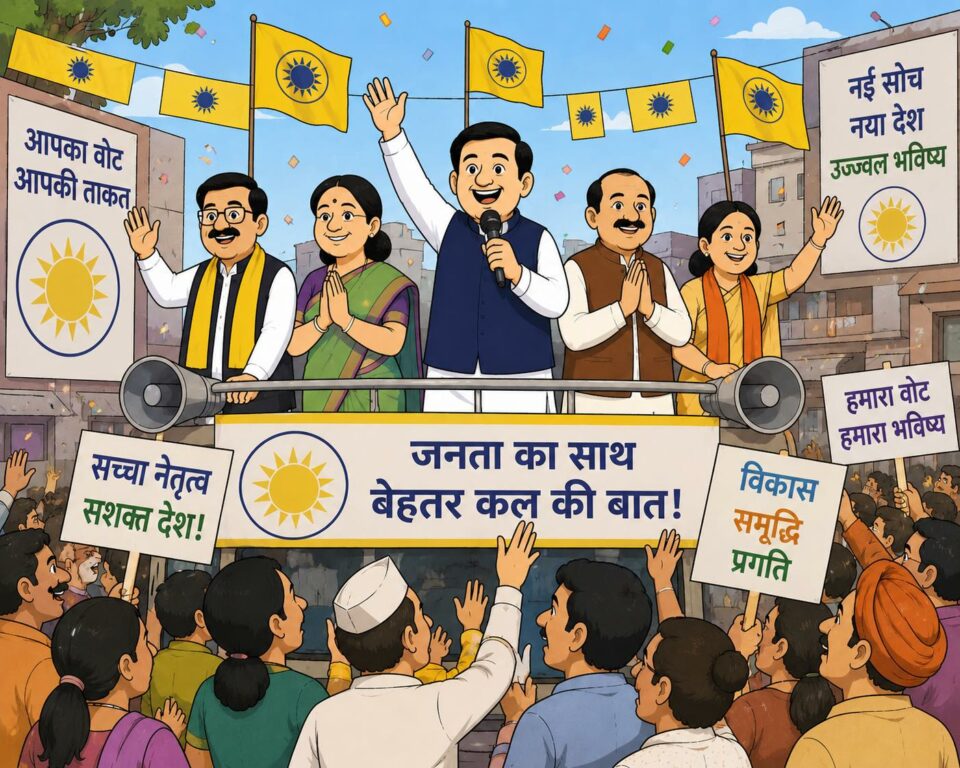
Every election today seems driven by faces, slogans, optics, and social media influence. Leaders are marketed like brands. Political debates resemble fan wars. In the middle of this spectacle, one fundamental question is rarely asked: what does a party actually stand for?
That question matters because politics without ideology eventually becomes a struggle for power without direction.
Ideology is not blind dogma. It is a framework of beliefs that shapes how a government approaches the economy, welfare, national security, social justice, and individual liberty. It defines priorities. Politics is merely the instrument through which those priorities are implemented.
The real danger begins when ideology is replaced by identity or personality worship. Voting purely through the lens of caste, religion, dynasty, language, or emotional attachment weakens democratic thinking. Identity is inherited. Ideology is consciously chosen.
That distinction changes everything.
A citizen guided by ideology evaluates policies, institutions, and long term national direction. A citizen driven only by personalities often becomes emotionally invested in defending leaders, regardless of performance or contradictions.
History repeatedly shows the consequences. Movements built entirely around individuals become fragile once ambition, succession battles, or political compulsions emerge. But ideology gives political movements continuity. It creates internal discipline. More importantly, it gives ordinary workers and supporters the moral right to question leaders when they drift away from core principles.
This is where Indian politics faces a deeper crisis today.
Across parties, political conversation is increasingly dominated by alliances, defections, caste arithmetic, electoral management, and family succession. Ideological clarity often appears secondary. Loyalty itself has become transactional.
The result is visible across the system. Governance debates receive less attention than political maneuvering. Optics frequently overshadow substance. Public discourse becomes centered on who joins whom, who betrayed whom, and who controls power.
But democracies do not become stronger through permanent political excitement. They become stronger when citizens start demanding ideological consistency and policy clarity.
What economic philosophy does a party believe in?
What institutional values does it protect?
How does it balance welfare with growth?
What is its long term national vision?
These are the questions that create informed citizens instead of political followers.
Perhaps Indian politics does not merely need new leaders. It needs the return of ideological seriousness. Because in the end, nations are shaped less by the ambitions of individuals and more by the strength of the ideas that survive beyond them.
As an independent media platform, we do not take advertisements from governments and corporate houses. It is you, our readers, who have supported us on our journey to do honest and unbiased journalism. Please contribute, so that we can continue to do the same in future.
