
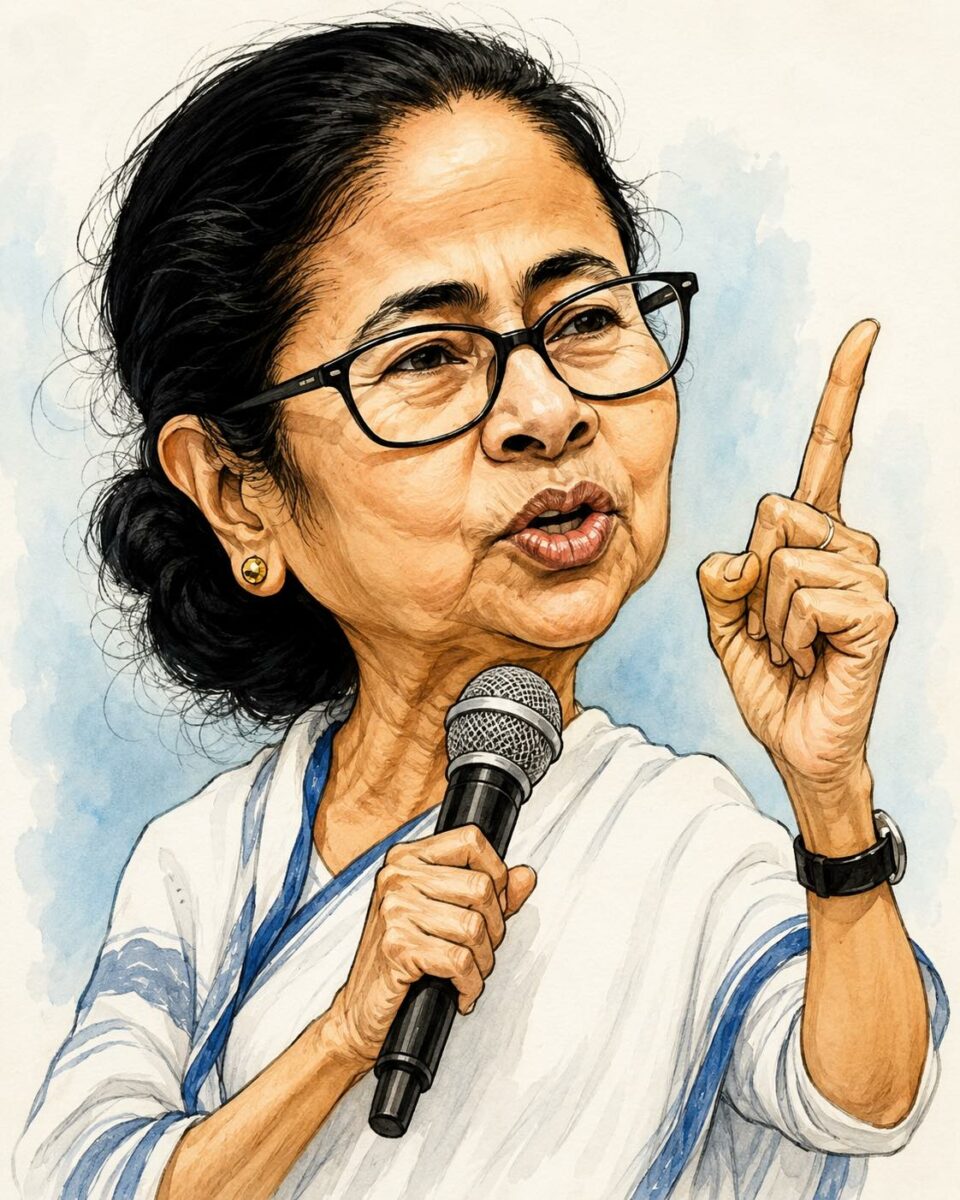
West Bengal’s political mood has clearly shifted. Anti incumbency against the Trinamool Congress is no longer a theory pushed only by opposition parties. Complaints about corruption, syndicate culture, local strongmen and administrative fatigue have created visible public anger across sections of voters.
But assuming this automatically marks the political end of Mamata Banerjee could be a serious misreading of Bengal politics. Because Mamata Banerjee has never operated like a conventional Chief Minister.
Most regional leaders become weaker when they are put under pressure. Mamata often becomes stronger. The more cornered she appears, the more she shifts from administrator to agitator. That transformation is what makes her politically dangerous for the BJP.
The BJP’s standard political model across states is built around organizational expansion, central pressure, narrative dominance and leadership projection. It has worked successfully against several regional forces. But Bengal is not an easy ideological battlefield. Here, emotion often overrides structure.
Unlike the Left Front, which depended heavily on a disciplined but rigid party machinery, Mamata’s politics revolves around personality, confrontation and emotional connection with Bengali identity. If her government weakens, she does not disappear quietly into institutional politics. She returns to the street.
That is where the BJP’s real challenge begins.
A weakened Mamata can easily reposition herself as a victim of Delhi’s political aggression. Every investigation, arrest or crackdown can be reframed into a larger narrative of Bengali pride versus central domination. In Bengal’s political culture, that narrative still carries enormous emotional weight.
Ironically, a Mamata Banerjee with reduced administrative burdens may become more politically aggressive than a Mamata running the state government daily.
There is also another uncomfortable reality for the BJP. Despite years of growth in West Bengal, the party still struggles to produce a mass Bengali leader with the same cultural instinct and emotional vocabulary as Mamata. Elections can be nationalized. Bengal’s political psychology cannot.
The BJP has built a powerful electoral machine in the state. But it still lacks a face that naturally connects with Bengal’s street level political culture in the way Mamata does.
That is why even during phases of visible anti incumbency, she continues to dominate the political conversation.
Could there ever be another NDA chapter between Mamata and the BJP, similar to the Vajpayee era? In Indian politics, nothing is impossible. But after years of direct ideological warfare, such a move would require a dramatic political reinvention from both sides. At this stage, it remains highly unlikely.
The public anger against the TMC is real. The electoral warning signs are real. But Bengal’s politics has never been a simple arithmetic exercise.
As India moves toward 2029, the BJP may discover that defeating Mamata electorally is only one battle. Managing a Bengal where Mamata Banerjee returns to full time opposition politics could become an even bigger challenge.
Because unlike the old Left leadership that slowly faded with time, Mamata Banerjee’s political instinct is built on resistance.
And in Bengal, resistance still has a powerful audience.
As an independent media platform, we do not take advertisements from governments and corporate houses. It is you, our readers, who have supported us on our journey to do honest and unbiased journalism. Please contribute, so that we can continue to do the same in future.
