
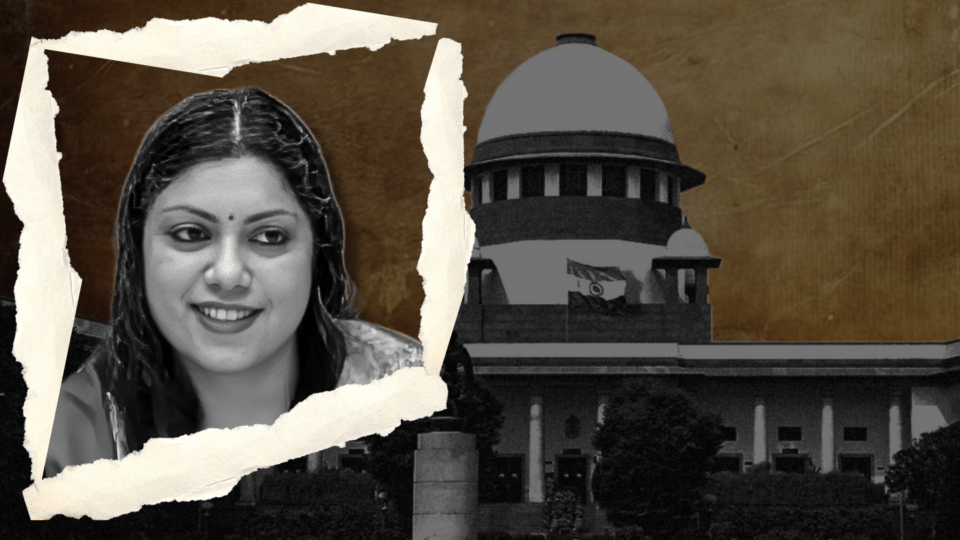
The curious case of Gautam Buddha Nagar District Magistrate Medha Roopam, daughter of CEC Gyanesh Kumar.
A public servant approaches the Supreme Court. She happens to be the daughter of the sitting Chief Election Commissioner. Her case is listed before a particular bench despite questions over the prevailing roster. Then the live proceedings are muted.
Now a lawyers’ body has written to Chief Justice of India Surya Kant seeking answers.
The Lawyers’ Association for Constitution has raised concerns over what it describes as the “out of turn” listing of petitions filed by Gautam Buddha Nagar District Magistrate Medha Roopam and the Uttar Pradesh government against an Allahabad High Court judgment.
But what is this case about?
Aakriti Chaudhary, a Delhi University student and activist, was arrested in connection with the April 2026 workers’ protests in Noida. The Uttar Pradesh government subsequently invoked the National Security Act against her, alleging her involvement in instigating the protests.
As Gautam Buddh Nagar District Magistrate, Medha Roopam passed the NSA detention order.
The Allahabad High Court later quashed the detention, finding that the material relied upon did not establish the allegations of inciting violence and that the detention order lacked sufficient basis. It also directed ₹5 lakh compensation to Chaudhary, to be recovered from the salaries of officials involved, including Roopam, and made strong observations about the District Magistrate’s conduct.
Roopam and the Uttar Pradesh government then approached the Supreme Court.
The Supreme Court initially stayed the operation of the relevant portions of the High Court judgment. It subsequently clarified that the stay is confined to the strictures against Roopam and the ₹5 lakh compensation direction. The High Court’s decision quashing Chaudhary’s NSA detention remains in force.
But the controversy now extends beyond the merits of the detention case.
What makes the listing particularly noteworthy is that Justice B.V. Nagarathna’s bench was already hearing connected cases arising from the same Noida protests, and preventive detention matters were within her roster. Yet the Gautam Buddha Nagar DM’s petition was specially heard by a bench headed by Justice Satish Chandra Sharma, whose regular roster did not include such matters. There is no public explanation for why the case was assigned this way.
The lawyers’ association alleges that the matter was specially assigned to a particular bench despite the prevailing roster. It has also questioned why the live proceedings were muted, preventing journalists from following the hearing.
These are allegations, not established findings. There may be explanations for both the listing and the muted proceedings.
But when a case involving the daughter of the sitting CEC is listed in circumstances that a lawyers’ body itself has questioned, transparency becomes especially important.
The Supreme Court has enormous public trust invested in it. That trust depends not only on the judgments it delivers, but also on confidence that its procedures are transparent, consistent and capable of withstanding scrutiny.
The questions raised by the lawyers’ body therefore deserve clear answers.
As an independent media platform, we do not take advertisements from governments and corporate houses. It is you, our readers, who have supported us on our journey to do honest and unbiased journalism. Please contribute, so that we can continue to do the same in future.
