
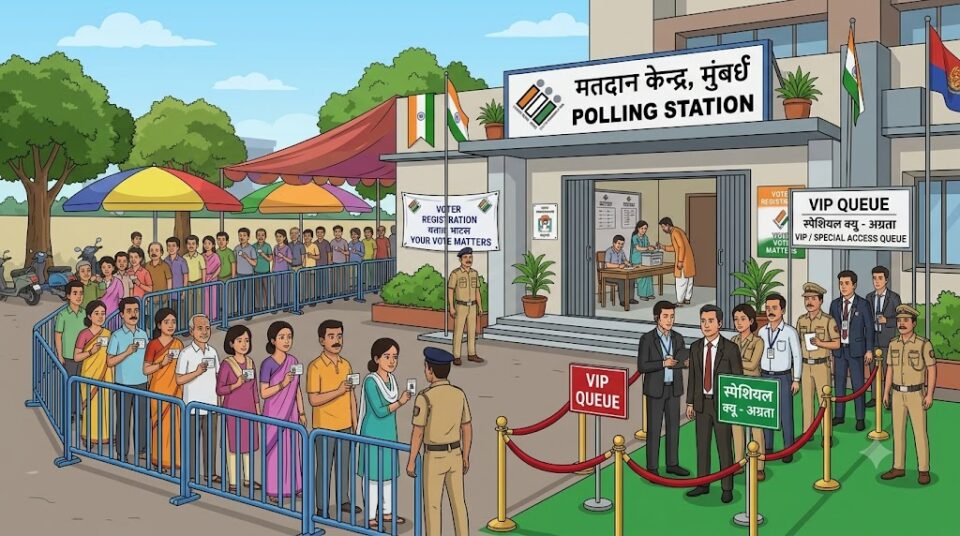
India may be quietly becoming a two tier democracy.
VIPs: Very Important People.
NIPs: Not Important People.
One class gets access, attention, facilitation and influence. The other gets rules, queues, paperwork, notices and silence.
According to a Hindustan Times report, the Election Commission’s BLO App has reportedly been updated with a feature literally called “Mark VIP”, allowing officials to identify certain electors as VIPs during voter verification. The update is recorded on the App Store as “mark VIP elector related changes”.
The Times of India has previously reported that VIP electors can include MPs, MLAs, senior bureaucrats, former ministers and legislators, celebrities and other prominent citizens. The ECI has said that VIP status does not entitle them to special treatment at polling stations. However, reports on the current SIR indicate that marked electors are being contacted first for verification and, in some cases, their documents are being collected directly.
Apparently, we now have a system where a VIP can receive personalised attention at the verification stage while the ordinary citizen is expected to navigate the process on their own.
And once such a distinction is institutionalised, what prevents the logic of preferential treatment from extending further? Today it may be verification at your doorstep. Tomorrow, could it become a separate queue at a polling station, additional assistance, more time or fewer procedural requirements?
These are not claims about what the ECI is currently doing at polling stations. They are questions that arise when a distinction between VIP and ordinary electors is formally built into an electoral process.
Across public life, the ordinary citizen increasingly experiences the State from the other side of the counter.
You wait for an appointment. You stand in a queue. You submit documents. You prove your identity. You follow instructions. You pay your taxes. You wait for your date in court. And when you need the system to listen, you often discover that access itself has become a privilege.
That is how a two tier democracy can emerge without anyone formally declaring it.
Not through a constitutional amendment or a change in the law, but through thousands of small institutional practices that quietly tell citizens that some people matter more than others.
The Constitution does not recognise VIP citizens and NIP citizens.
It recognises citizens.
Perhaps the most dangerous thing about institutional inequality is not that it happens in plain sight. It is that we slowly become accustomed to it.
And one day, we may discover that we stopped asking why some citizens are treated as important while the rest are simply expected to comply.
As an independent media platform, we do not take advertisements from governments and corporate houses. It is you, our readers, who have supported us on our journey to do honest and unbiased journalism. Please contribute, so that we can continue to do the same in future.
