
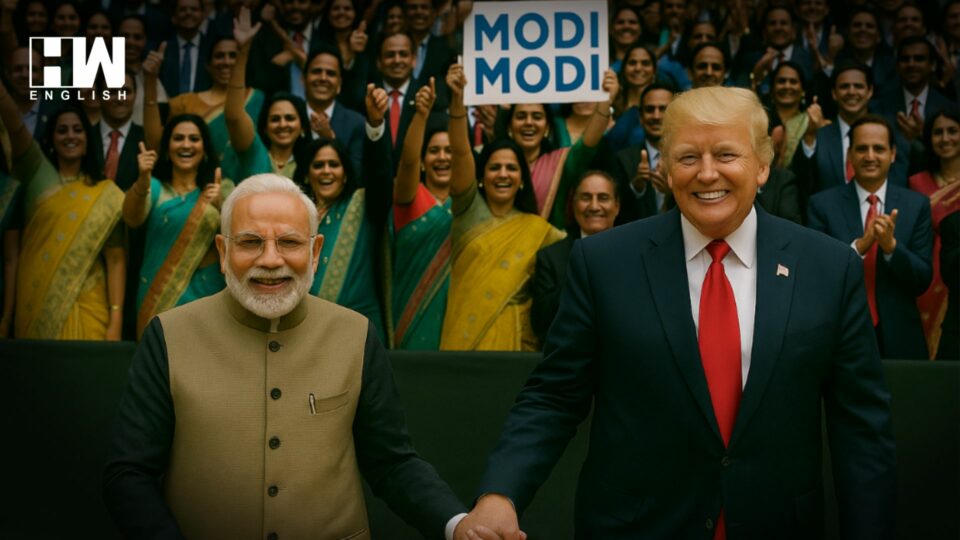
Despite being a wealthy and influential community, Indian-Americans have found themselves increasingly marginalized under the Trump 2.0 regime — and the reasons are twofold
The return of Donald Trump as the 47th President of the United States was widely celebrated in both India and the US, as political analysts from both nations anticipated a revival of the iconic Modi-Trump friendship over the next four years.
Little did anyone know that both India and the US would experience an all-time low in their bilateral relationship — a strain that would primarily affect Indo-Americans, who constitute a significant portion of the US electorate and occupy several key positions in the American administration.
Indian-Americans are the second-largest Asian community in the United States, accounting for about 21% of the Asian population, with 5.2 million individuals of Indian descent. Roughly 60% of them have resided in the country for over a decade, and 51% have obtained US citizenship through naturalization. India also remains one of the top sources of international students in the US.
Despite being a wealthy and influential community, Indian-Americans have found themselves increasingly marginalized under the Trump 2.0 regime — and the reasons are twofold.
Recently, a councilman from Florida, Chandler Langevin, called for the mass deportation of Indians from US soil and hurled vile remarks at Indian-origin Congressman Raja Krishnamoorthi, mocking his name as “unpronounceable” and claiming his country of origin was Tatooine — a fictional planet from Star Wars.
In another post on X, Langevin said, “Indians come here to work so they can send money back to India. That isn’t ‘America First.’ That’s taking advantage of America.”
@DHSgov I would like to report a foreign occupier.
Name: Unpronounceable
Country of origin: Tatooine pic.twitter.com/SHyAVD9k2u
— Chandler Langevin (@ChandlerForPB) October 19, 2025
Continuing his tirade against the Indo-American community, Langevin, on September 18, 2025, again posted on X, stating, “Indians don’t assimilate. They’re here to drain our pockets and get back to India rich — or worse — to stay.”
Similar hate remarks targeted another Indian-origin conservative commentator and longtime Trump ally, Dinesh D’Souza, from the MAGA wing. When D’Souza responded to a White House renovation post on October 21, he was bombarded with abuse, with one user branding Indians as a “disgusting race of slaves.” Shocked by the hostility, D’Souza wrote, “In a career spanning 40 years, I have never encountered this type of rhetoric. The Right never used to talk like this. So, who on our side has legitimized this type of vile degradation? It’s a question worth thinking about.”
This racial hate is not restricted to the Indo-American community at large but now extends to Indo-American politicians in the Trump administration, as well as to leaders like Tulsi Gabbard — who, though not of Indian origin, is Hindu by faith.
During the Diwali festival, when Indo-American leaders from the Trump administration extended festive greetings on X, they were met with scathing remarks from the MAGA camp.
When FBI Chief Kash Patel posted Diwali wishes, far-right pastor Joel Webbon mocked him, saying he should “go back to India and worship demons.”
But why this sudden hate against Indians in America? The diaspora — once celebrated during the Trump 1.0 era — is now being marginalized by the American conservative right. Many Americans, whose ancestors settled in a foreign land centuries ago, now feel that Indians are coming to their country, taking away job opportunities, and leaving Americans unemployed. This sentiment has likely fueled President Trump’s strong criticism of the H1B visa program in his second term.
The very same Indian diaspora that once played a key role in strengthening US–India friendship during Trump’s first term — and symbolized the famous Trump–Modi camaraderie — now finds itself silenced as MAGA fringes hurl abuse at them on social media. Ironically, Indian-Americans have been among the biggest donors to the Republican Party and voted for Trump in the last election.
On the flip side, isolated incidents involving members of the Indian-American community — such as petty crimes like shoplifting or rash driving — have further worsened perceptions. During the recent Diwali celebrations, videos circulated on X showing Indians bursting firecrackers on public streets after 10 PM, prompting police intervention for violating local noise and safety regulations. Such incidents fueled outrage among MAGA supporters.
Similar complaints emerged during Ganesh Chaturthi celebrations when videos from Lewisville, Texas, showed Indian groups playing drums loudly in the streets, sparking another wave of social media backlash that further tarnished the community’s image.
Petty crimes and illegal immigration from India to the United States have only added to these tensions. The Indian diaspora — once vocal supporters of Prime Minister Narendra Modi during his US visits — now find themselves without his backing amid the chill in India–US relations. Nor do they have the support of President Donald Trump, leaving them politically isolated.
For now, the future of Indo-Americans over the next 3.5 years under the Trump administration seems uncertain — a case of being caught between two stools. Time will tell how the relationship between the two nations evolves, and with it, the fate of the Indo-American community.
As an independent media platform, we do not take advertisements from governments and corporate houses. It is you, our readers, who have supported us on our journey to do honest and unbiased journalism. Please contribute, so that we can continue to do the same in future.
