
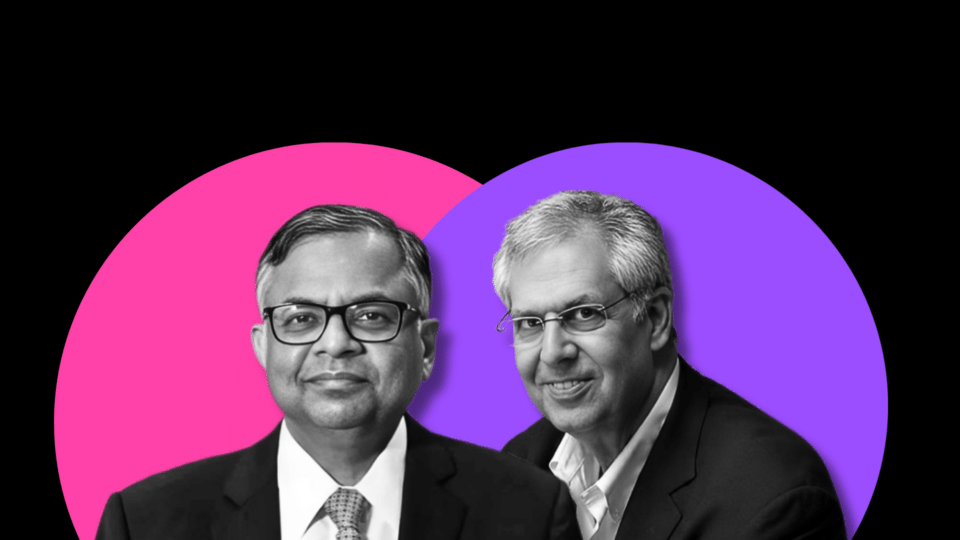
The public face of the current Tata crisis is a disagreement between Noel Tata and N Chandrasekaran over Chandrasekaran’s continuation as Chairman of Tata Sons. But I suspect the real conflict is much deeper.
For me, it begins with one issue above everything else: the proposed listing of Tata Sons.
Tata Trusts owns about 66 percent of Tata Sons. The Trusts have opposed the listing and argued that Tata Sons should explore every permissible alternative to remain private. The Tata Sons board, after the RBI rejected its application to surrender its regulatory status, has now decided to move towards listing. What makes this particularly significant is that the same board had supported keeping Tata Sons unlisted in 2024.
Why does this matter so much?
Because listing Tata Sons could fundamentally alter the balance of power within the Tata Group. A private Tata Sons gives the Trusts enormous influence as the controlling shareholder. A listed Tata Sons would bring public shareholders, institutional investors, market scrutiny and a different set of governance obligations into the heart of the group.
That leads to the second issue: who should ultimately determine the direction of Tata Sons? The Trusts, as the controlling shareholder and custodians of the Tata legacy, or a professionally managed board with greater operational autonomy?
Then comes the third issue: capital allocation. Chandrasekaran has transformed the group through large strategic bets in Air India, electronics, semiconductors, digital businesses and other new areas. Some of these businesses require enormous capital and have yet to generate returns. Air India, in particular, has become a major financial commitment. Reports suggest that concerns over the performance and capital requirements of some unlisted businesses have contributed to the differences between Chandrasekaran and the Trusts.
This is really a debate about the future philosophy of the Tata Group. Should Tata continue making long term strategic bets, even when they involve significant short term costs? Or should capital allocation become more conservative and return driven?
Then there is the question of trust. Chandrasekaran’s relationship with Noel Tata appears to have deteriorated over time. His reappointment had already become contentious months before the present crisis.
Chandrasekaran announced in August that he would not seek another term. The Trusts accepted that decision and began looking towards succession. Then, dramatically, the board reversed course and offered him another five years.
And this brings us to the most extraordinary part of the story.
On September 17, the Tata Sons board backed Chandrasekaran for another five years and decided to proceed towards listing Tata Sons. Noel Tata opposed both decisions. Tata Trusts has since challenged the validity of Chandrasekaran’s reappointment, arguing that its rights under the Articles of Association were not respected.
So this is no longer simply Noel Tata versus Chandrasekaran.
It is becoming a contest over who defines the future of Tata Sons.
And there is one historical factor that cannot be ignored.
Ratan Tata was the person who could bridge the Tata family, the Trusts, the board and professional management. After his death, that bridge disappeared. Noel Tata now heads the Trusts, while Chandrasekaran represents the professional management of Tata Sons.
Perhaps that is why this conflict has become so intense.
The real question may not be who gets another five years.
It may be what kind of Tata Group emerges after Ratan Tata: one primarily shaped by the Trusts as custodians of the Tata legacy, or one increasingly shaped by a professional corporate board and management.
The battle over the chairman may simply be the visible expression of that much larger struggle.
As an independent media platform, we do not take advertisements from governments and corporate houses. It is you, our readers, who have supported us on our journey to do honest and unbiased journalism. Please contribute, so that we can continue to do the same in future.
