
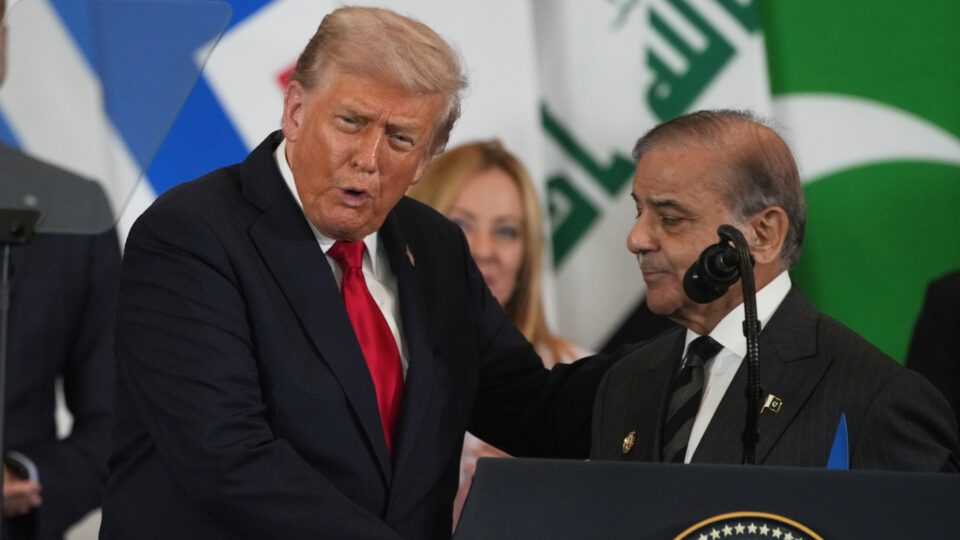
Pakistan’s decision to even consider joining a U.S.-led force in Gaza exposes the deep hypocrisy of its foreign policy, a state that has been preaching anti-Israel rhetoric to its citizens while quietly seeking global legitimacy by aligning with Washington
Recently, in an interview with Geo News, Pakistan’s Defense Minister Khawaja Asif said that Pakistan is mulling to send its army as part of an International Stabilization Force in Gaza for the demilitarization of the region.
Asif stated, “The government will take a decision after going through the process, and I don’t want to pre-empt anything.” He added, “If Pakistan has to participate in it, then I think it will be a matter of pride for us. We will be proud to do it.”
What is the International Stabilization Force which will be deployed in Gaza?
US President Donald Trump, in his 20-point plan, has proposed setting up an International Stabilization Force in Gaza to ensure the security of officials working there to end the war.
According to reports, a temporary International Stabilization Force in Gaza, authorized by a Board of Peace transitional governance administration, would be established, as mentioned in the draft resolution.
The International Stabilization Force would be mandated to secure border areas with Israel, Egypt and the “newly trained and vetted Palestinian police force”, protect the civilians in Gaza and manage humanitarian aid operations.
The ISF would ensure the demilitarization process of the Gaza strip, which includes destructing and preventing the rebuilding of the military, terror, and offensive infrastructure and permanent decommissioning of weapons from non-state armed groups.
The draft resolution say that the ISF has been given the authority to disarm Palestinian militant group, Hamas.
A month ago, Israel and the Palestinian militant group Hamas came to a ceasefire and agreed to a hostage release deal as mentioned in the Trump’s 20-point plan.
Pakistan bans Tehreek-e-Labbaik
After US President Donald Trump brokered a ceasefire between Israel and the militant group Hamas on October 8, Pakistan’s Prime Minister Shahbaz Sharif welcoming the ceasefire, has been a frontrunner in heaping praise on the US President.
While Pakistan’s establishment has welcomed the Israel–Hamas ceasefire, public sentiment within the country tells a very different story.
The far-right political party in Pakistan, Tehreek-e-Labbaik (TLP), headed by Saad Rizvi, has been taking to the streets to oppose the ceasefire. On October 23, deadly clashes broke out in Lahore during anti-Israel protests, leaving at least five people dead. Following the incident, the Pakistan government banned Tehreek-e-Labbaik.
The Pakistan Prime Minister’s office said in a statement, “The Federal Cabinet unanimously concluded that TLP is involved in terrorism and violent activities.”
Pakistan’s Public Opinion
The highly radicalized society of Pakistan has historically held a hostile view toward Israel, which is why Pakistan still does not recognize the Jewish state in the Arab land.
Pakistan’s hostility toward Israel runs so deep that its passports explicitly state, “This passport is valid for all countries of the world except Israel.”
If a US-brokered ceasefire could trigger such violent protests in Pakistan, imagine the magnitude of anger among the country’s civil society if the Pakistani army were to fight Hamas for its disarmament under the ISF, all in the name of a safe and secure Israel.
The extent of radicalization in Pakistan’s civil society and its admiration for Hamas was evident in the jubilant reception accorded to Hamas leaders in Pakistan-Occupied Kashmir in February this year. Viral videos on social media show Hamas leaders boarding luxury SUVs, surrounded by Jaish and Lashkar terrorists on bikes and horses, as they entered the Shaheed Sabir Stadium in Rawalakote.
If the Pakistani establishment decides to send its army to join the ISF, it will face a huge backlash from its own people, given how radicalized Pakistani society is. The country is already battling insurgencies in two of its four provinces, Balochistan and Khyber Pakhtunkhwa and any further unrest would only add fuel to the fire.
When Pakistani Army Killed 25,000 Palestinians
This wouldn’t be the first time the Pakistani army has gone against the very radical sermons it preaches to its own people. While the country showcases immense love for Palestinians and hostility toward the Jewish state since its inception, the very army of the Islamic Republic of Pakistan once butchered 25,000 Palestinians in the 1970s.
The Popular Front for the Liberation of Palestine (PFLP) a militant group formed by Dr. George Habash and Dr. Wadie Haddad in January 1968 hijacked the Tel Aviv–New York TWA Flight 741 on September 6, 1970. On the same day, Swissair Flight 100, flying from Zurich to New York, was hijacked and taken to Jordan, while Pan Am Flight 93 from Brussels to New York was diverted to Cairo by the same militant group.
These hijackings triggered a war between Jordan and the Palestinian resistance groups, which led to the killing of around 25,000 Palestinians by the Pakistan Army, then headed by General Zia-ul-Haq, who came to the aid of the Jordanian King.
Pakistan’s Afghan Flip Flop
Pakistan has often defied its own policies, doing the very opposite of what its establishment once stood for.
The Pakistan Army was a key ally in the US-sponsored campaign to counter Soviet expansion in Afghanistan during the Cold War. While Pakistan provided its territory as a strategic base for the United States, it also facilitated and supported the rise of militant Islamist groups in Afghanistan to fight the Soviet-backed regime. The Pakistan Army shared a close relationship with the Taliban, which peaked when the group took over Afghanistan in 2021. However, the romance didn’t last long, the Taliban and the Pakistani Army have since been locking horns, clashing along the Durand Line and causing severe casualties on both sides.
The Islamic Republic of Pakistan has consistently maintained a strategic silence when its former patron, the United States, committed grave atrocities against its Muslim brethren in Iraq, defying the very concept of Ummah that it so often professes, even as it appeals for a caliphate to radicalize its local population. Today, it continues that silence with its current patron, China, despite Beijing’s ongoing human rights abuses against the Uighur Muslim population.
Pakistan’s decision to even consider joining a U.S.-led force in Gaza exposes the deep hypocrisy of its foreign policy, a state that has been preaching anti-Israel rhetoric to its citizens while quietly seeking global legitimacy by aligning with Washington. For decades, Pakistan has fueled radicalism at home under the guise of Islamic solidarity, only to betray those very ideals when geopolitical convenience demands it. If Islamabad truly joins the ISF, it won’t just be fighting Hamas, it will be fighting the ghosts of its own double standards.
As an independent media platform, we do not take advertisements from governments and corporate houses. It is you, our readers, who have supported us on our journey to do honest and unbiased journalism. Please contribute, so that we can continue to do the same in future.
