
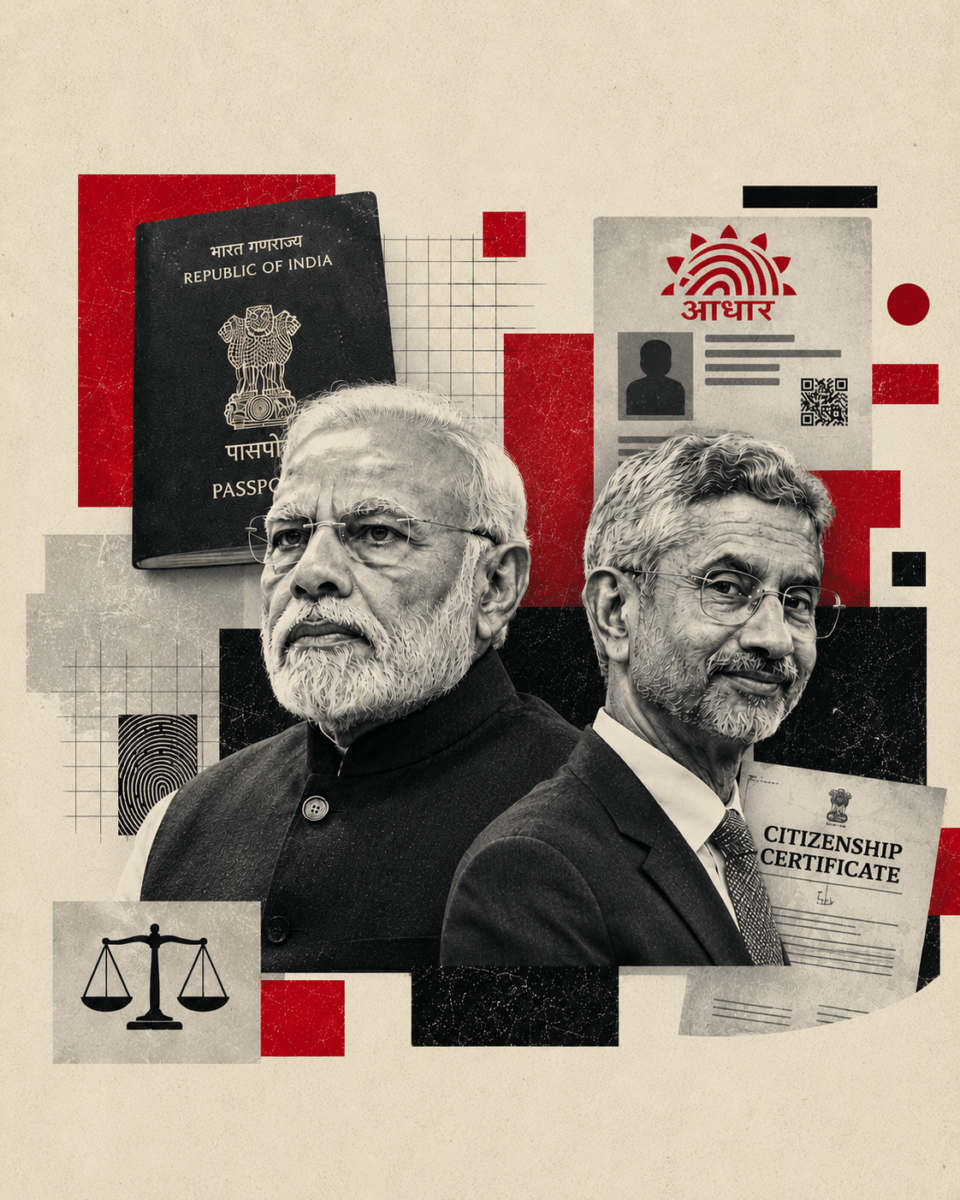
The Government of India has made a statement that has left many citizens puzzled. The Ministry of External Affairs has clarified that an Indian passport is not proof of Indian citizenship. It is a travel document.
That naturally raises a simple question.
If a passport is not proof of citizenship, and neither are Aadhaar, PAN or even a Voter ID, then what exactly proves that you are an Indian citizen?
Legally, India does not issue a single universal citizenship certificate to every citizen. Citizenship is determined under the Citizenship Act, 1955, through birth, descent, registration, naturalisation or incorporation of territory. In many cases, it has to be established through a combination of documents and records.
Each government document serves a different purpose. Aadhaar establishes identity and residence for accessing services. PAN is for taxation. Voter ID enables voting. A passport facilitates international travel.
But this is where the confusion begins.
A passport is not something you print at home. It is issued by the Government of India after document scrutiny and police verification. Naturally, most Indians assume that once the government issues them a passport, it has accepted them as Indian citizens.
So when the government says that even a passport is not conclusive proof of citizenship, an obvious question arises.
Then what is the definitive citizenship document?
If there is one, why do most Indians not know about it? If there is not one, how is an ordinary citizen expected to conclusively prove citizenship when required?
The issue is not merely legal. It is also about public confidence. Citizens should not have to guess which combination of documents may or may not establish something as fundamental as their citizenship.
This is not a political question. It is a basic administrative question that deserves a clear and unambiguous answer.
At the moment, many citizens are left feeling that they possess every major government document, yet none of them conclusively establishes who they are in the eyes of the State.
That uncertainty is avoidable. The government should clearly explain what constitutes conclusive proof of Indian citizenship and why documents that millions have relied upon for decades are now being described as having limited evidentiary value.
Clarity on citizenship is not just a legal necessity. It is essential for public trust.
Dear Readers,
As an independent media platform, we do not take advertisements from governments and corporate houses. It is you, our readers, who have supported us on our journey to do honest and unbiased journalism. Please contribute, so that we can continue to do the same in future.
As an independent media platform, we do not take advertisements from governments and corporate houses. It is you, our readers, who have supported us on our journey to do honest and unbiased journalism. Please contribute, so that we can continue to do the same in future.
