
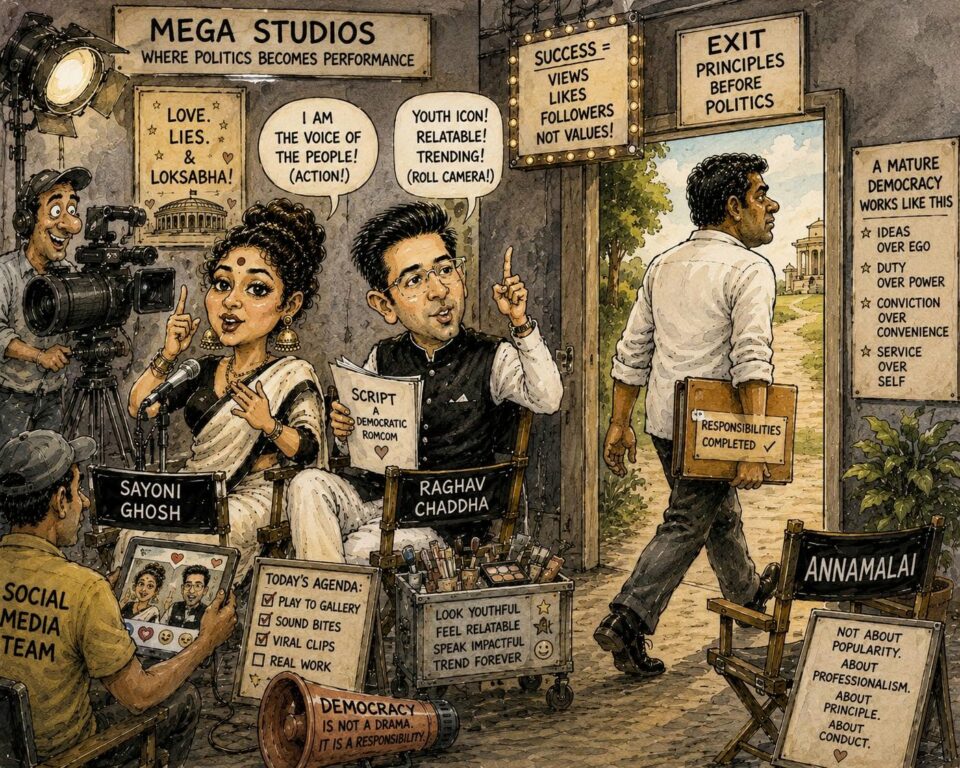
Dangers to a democracy is not disagreement. Democracies are built on disagreement. The real danger begins when politics becomes performance, when public representatives start treating leadership as theatre and principles as costumes that can be worn and discarded depending on the occasion.
I was genuinely disappointed watching popular young leaders like Sayoni Ghosh and Raghav Chadha.
When Sayoni Ghosh spoke in Parliament, I naively believed I was hearing the voice of the people she represented. I assumed I was listening to conviction. Instead, it felt as though I was watching a carefully crafted performance. As an actor, she is undoubtedly talented. But citizens do not elect actors to perform in Parliament. They elect representatives to speak honestly on their behalf.
I hope young Indians learn to distinguish between performance and leadership. The two are not the same.
Raghav Chadha always struck me differently. Even during his AAP years, there was something overly polished and performative about his politics. This is, of course, my personal opinion. His speeches often seemed designed more for headlines and social media clips than for serious public discourse. The packaging was impressive. The substance was less convincing.
Yet even then, I expected a degree of consistency. Recent developments suggest that political convenience can sometimes outweigh political conviction.
And that is precisely the problem.
Democracies do not weaken only because of bad policies. They weaken when public trust collapses. They weaken when citizens begin to believe that every speech is scripted, every position is negotiable and every principle is available for sale.
That is why I want to mention Annamalai.
I disagree with much of what he stands for politically. Yet, I am impressed with the manner in which he conducted himself. He diligently concluded the responsibilities entrusted to him during the recent elections, and then quit.
That is how a mature democracy is supposed to function.
Whatever the reason, whether emotional conviction, political calculation, or even fear of repercussions, he acted professionally. At the very least, he met his party’s top leadership, conveyed his decision, and parted ways amicably. No public drama, no shocks, no bad blood. Though I believe his ideological umbilical cord will always remain attached to the BJP, and he may eventually even return to their fold, he acted professionally.
Young Indians should be very careful about whom they admire in public life. Do not judge leaders by viral speeches, trending clips or dramatic performances. Judge them by consistency, integrity, professionalism and their willingness to stand by what they claim to believe.
Because when politics becomes theatre, democracy eventually pays the price.
As an independent media platform, we do not take advertisements from governments and corporate houses. It is you, our readers, who have supported us on our journey to do honest and unbiased journalism. Please contribute, so that we can continue to do the same in future.
