
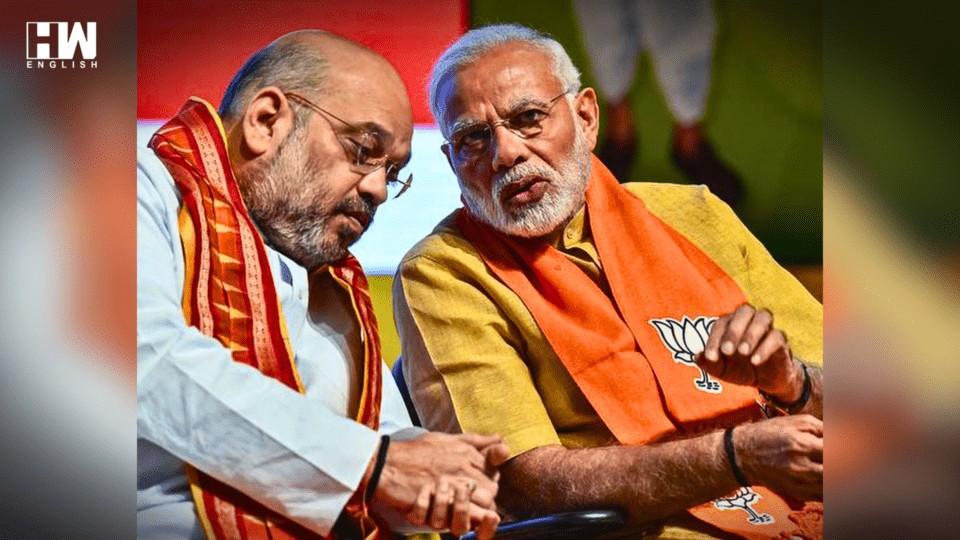
Why does a party that has relied so successfully on Narendra Modi’s electoral appeal for more than a decade suddenly need such a significant organisational restructuring?
Perhaps the answer lies in a realisation that the BJP may not say publicly, but its latest appointments seem to acknowledge.
Narendra Modi is still a popular leader. There is little doubt about that. But his popularity is not what it was in 2014. The 2024 Lok Sabha election was the first major warning. The BJP remained the largest party, but its tally fell from 303 seats to 240, forcing it to depend on allies to form the government.
Yet the BJP appeared to regain its confidence after its subsequent electoral successes. Especially in West Bengal. The Modi Shah formula was back. Once again, the party seemed to believe that its Supreme Leader could carry the political narrative.
Then came Gen Z.
The youth protests of 2026 changed something beyond the immediate issue that triggered them. A digitally native generation demonstrated that it could create a political narrative outside the BJP’s traditional communication ecosystem and sustain it nationally. The movement eventually forced the resignation of Education Minister Dharmendra Pradhan and, more importantly, dented the perception that the Modi government was politically untouchable.
Perhaps that is when the BJP realised that 2029 cannot be fought on the Modi Shah formula alone.
It needs the Sangathan again.
And suddenly, the new appointments begin to make sense.
Vasundhara Raje Scindia, who was seen as an adversary of the Modi Shah duo, had been politically sidelined despite remaining one of the BJP’s strongest mass leaders in Rajasthan. Now, she is back in the national structure. The message is clear. Regional heavyweights and their personal political networks may once again matter.
Smriti Irani’s return to a major organisational role, with responsibility for Uttar Pradesh, brings back a leader with considerable political visibility and public connect. In a state as electorally crucial as UP, the BJP clearly needs recognisable faces who can connect with voters beyond the central leadership.
Then there is Ram Madhav.
Once one of the most important political bridges between the RSS and the BJP, and widely seen as an RSS favourite, his return signals something equally important: the BJP may once again need the full strength and undeterred support of the Sangh organisation.
And Sandeep Pathak is perhaps the most revealing appointment of all.
A former AAP strategist who helped build the party’s formidable organisational and electoral machinery, Pathak brings an understanding of the BJP’s competition from the inside. His appointment suggests that the BJP wants to understand not merely how its opponents campaign, but how they organise, mobilise and build political networks.
Put all of this together and the picture becomes much clearer.
This is not simply a reshuffle. It is a recalibration.
The BJP may have realised that Modi remains its biggest electoral asset, but he can no longer be its only electoral strategy.
Modi and Shah may still be the BJP’s most powerful leaders. But they may no longer be the be all and end all of the BJP.
Looking towards 2029, the party appears to be rediscovering an old lesson from its own history.
A powerful leader can win an election.
But only a powerful Sangathan can keep winning elections.
And perhaps the most significant message from this restructuring is that the BJP has finally realised that the political India of 2029 will not be the India of 2014.
The voters have changed. The political conversation has changed.
Gen Z has arrived.
And the BJP appears to be preparing for it.
As an independent media platform, we do not take advertisements from governments and corporate houses. It is you, our readers, who have supported us on our journey to do honest and unbiased journalism. Please contribute, so that we can continue to do the same in future.
