
There may be several reasons why the Modi government does not intend to strike Pakistan this time, but the most significant factor is the rise in Pakistan’s geopolitical profile after the recent India–Pakistan conflict, in which U.S. President Donald Trump played a crucial role
Delhi faced a deadly terror attack on November 10, 2025, when a car loaded with ammonium nitrate exploded near the Red Fort. The blast claimed 15 lives and left several others injured. The Government of India officially declared the incident a terror attack only on November 12, two days after the blast. The delay by the Modi government in declaring the attack as “an act of terror” has raised several eyebrows across the country.
A day before the Delhi blast, the Haryana Police and J&K Police made a major breakthrough by recovering 350 kg of explosives, including 14 bags of ammonium nitrate weighing around 100 kg, along with an AK-47 rifle, 84 live cartridges, timers, 5 litres of chemical solution, and a total of 48 items suspected to be used in assembling Improvised Explosive Devices (IEDs) in Faridabad, Haryana.
After the blast, the authorities made another huge seizure, confiscated 2,900 kg of explosives in a joint operation by the J&K Police and Haryana Police.
Meanwhile, the Gujarat ATS foiled a ricin-based terror plot by arresting Saiyed, an MBBS doctor from Hyderabad, accused of planning a major attack using weapons and the lethal poison ‘ricin’.
The suspects were not ordinary individuals from disadvantaged backgrounds, but well-qualified doctors, conspiring to execute a large-scale terror operation within India. This led officials to label it a “White-Collar Module”, with Al-Falah University emerging as a suspected breeding ground for these radicalized operatives who were later nabbed by the investigative agencies. Reports say that this ‘White-Collar Module’ has a direct link with the Pakistan-based terrorist group Jaish-e-Muhammad.
After the Pahalgam attack, when India and Pakistan agreed to a ceasefire following four days of conflict, Prime Minister Narendra Modi announced a decisive new policy, drawing a red line on future terror strikes: “Any act of terror from Pakistan will be considered an act of war.” The Modi Govt however doesn’t seem to again lock horns with Islamabad after the Delhi terror attack.
PM Modi’s differential approach to Delhi blast vis-à-vis Pahalgam Attack
After the deadly Pahalgam Attack that happened on 22 April, 2025, which claimed 26 lives, PM Modi shortened his Saudi Arabia visit and immediately headed to New Delhi and urgently chaired a meeting with External Affairs Minister Dr. S. Jaishankar, National Security Advisor Ajit Doval and Foreign Secretary Vikram Misri.
In an exceptionally fiery address in Bihar, Prime Minister Narendra Modi issued a stern warning to those behind the Pahalgam attack. “Those who carried out this act of terror and those who supported, funded, or planned it, will face a punishment beyond imagination. We will not rest until justice is served. From the soil of Bihar, I send this message to the world: India will hunt down every terrorist and every accomplice. We will pursue them to the ends of the Earth,” he vowed.
PM Modi’s voice was filled with fury and rage as he declared that India’s resolve would not be broken, that terror would never go unpunished. His powerful words set expectations sky-high anticipating a decisive and forceful response from New Delhi to avenge the Pahalgam attack. A strong response was expected.
PM Modi stood by his words. Following the Pahalgam attack, after 15 days, India launched Operation Sindoor, with the Indian Air Force striking multiple terror camps in Pakistan, and later targeting several Pakistani airbases. Once the mission’s objectives were accomplished, India agreed to a ceasefire with Pakistan. The ceasefire was however announced by US President Donald Trump, sparking another controversy to be discussed in another opinion piece.
Such strong resolution wasn’t displayed by Prime Minister Narendra Modi after the Delhi Blast. This time, PM Modi was in Bhutan to attend the 70th Birth Anniversary Celebrations of the Bhutan King Jigme Singye Wangchuck. Unlike during the Pahalgam attack, he did not cut short his foreign visit, he continued with his Bhutan schedule.
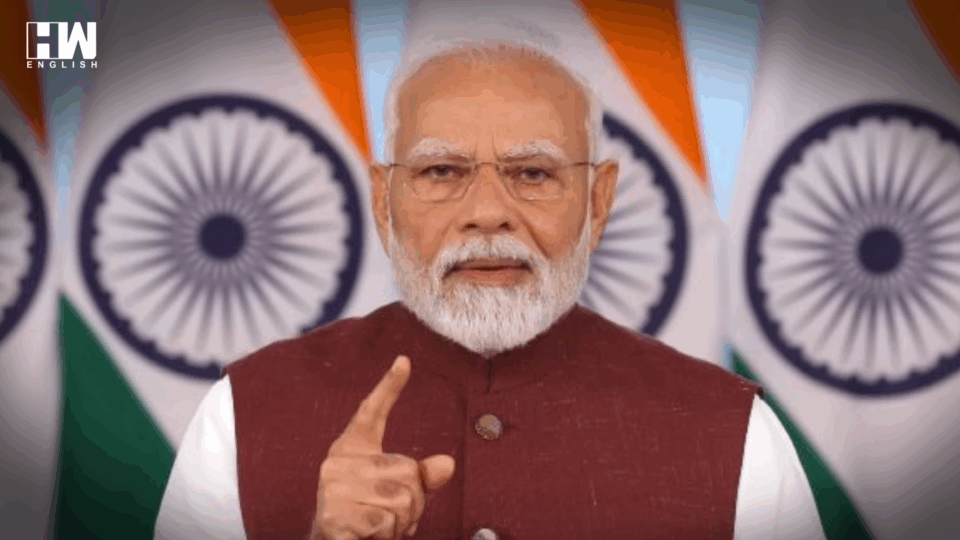
On November 21, PM Modi in a speech from Bhutan said, “Today, I come here with a very heavy heart. The horrific incident that took place in Delhi yesterday evening has deeply saddened everyone. I understand the grief of the affected families. The entire nation stands with them today. I was in touch with all the agencies investigating this incident throughout last night. Our agencies will get to the bottom of this conspiracy. The conspirators behind this will not be spared. All those responsible will be brought to justice.” This time, the Indian Prime Minister was calm and composed. The rage that PM Modi displayed after the Pahalgam attack in his Bihar speech was missing. And now, 15 days after the Delhi blast, the Modi government does not appear to be preparing for war with its nuclear-armed western neighbor.
PM Modi was seen actively participating in several public engagements, unlike the period after the Pahalgam attack. He visited South Africa, attended the G20 Summit, delivered the Ramnath Goenka Lecture, and addressed the nation after the BJP’s sweeping victory in the Bihar Assembly Election, even taking a swipe at the Congress for its poor poll performance. He also attended the Ayodhya Ram Temple flag-hoisting ceremony along with RSS Chief Mohan Bhagwat and Uttar Pradesh Chief Minister Yogi Adityanath. Such frequent public appearances were not seen from PM Modi in the aftermath of the Pahalgam attack.
Strong statements by Home Minister Amit Shah and Defence Minister Rajnath Singh did make headlines after the Delhi blast, but the Prime Minister’s previously declared doctrine, ‘Any act of terrorism from Pakistan is an act of war’, appears conspicuously absent this time.
There may be several reasons why the Modi government does not intend to strike Pakistan this time, but the most significant factor is the rise in Pakistan’s geopolitical profile after the recent India–Pakistan conflict, in which U.S. President Donald Trump played a crucial role. Pakistan’s Army Chief and Field Marshal Asim Munir, now an unchallenged power center in Pakistan, has made his way to the White House, where U.S. President Donald Trump hosted him for dinner. Pakistan has also been invited to chair several important meetings, including one focused on ending the Israel–Hamas conflict, where a 20-point programme was discussed. Post-Op Sindoor, Pakistan has been heading multiple UN-based committees and has secured several loans from the IMF and the World Bank. None of this happens without the blessings of the United States of America.
India now has 2-unelected heads of state on its eastern and western front — Asim Munir to the west and Muhammad Yunus to the east. Meanwhile, Prime Minister Modi’s close friend Donald Trump appears to be flirting with India’s biggest adversary, Pakistan. Relations with China, India’s northern neighbor, have only recently begun to cool, and India’s long-time ally Russia is deeply engaged in a prolonged war with Ukraine, leaving it unable to support India militarily as it once did in 1971.
India will therefore need to tread carefully before initiating any kinetic action against Pakistan. For now, it appears that Prime Minister Modi may have to place his ‘Act of War’ doctrine is in abeyance.
As an independent media platform, we do not take advertisements from governments and corporate houses. It is you, our readers, who have supported us on our journey to do honest and unbiased journalism. Please contribute, so that we can continue to do the same in future.
