
Post-Operation Sindoor and the ouster of Bangladesh’s Prime Minister Sheikh Hasina, it seems there is a concerted attempt by Pakistan to contain India on both its eastern and western borders, while India is trying to do the same with Pakistan via Afghanistan
Asia has become a battleground for the proxies of India and Pakistan being used against each other. While both nations have exchanged several rounds of fire along the border post-Pahalgam attack, tensions between them still remain unresolved. Though India and Pakistan share deep enmity, a high-intensity war would be extremely costly for both. So, do the two nuclear-armed nations – separated by the Radcliffe Line 78 years ago – want to bleed each other through their proxies? Is proxy warfare the new future of the Asian subcontinent? Is India using Afghanistan against Pakistan? Is Pakistan trying to create an uncertainty for India from the east via Bangladesh? And will this escalation lead to a hot confrontation between the two nuclear-powered nations?
A Fresh India-Afghanistan Bonhomie
The recent faceoff between Pakistan and Afghanistan during Foreign Minister Amir Khan Muttaqi’s jubilant visit to India was closely observed by people in India and around the world. In an attempt to eliminate Tehreek-e-Taliban Pakistan (TTP) chief Noor Wali Mehsud, Pakistan carried out an airstrike in Kabul, which irked the Taliban. In retaliation, Taliban-ruled Afghanistan escalated the conflict by attacking multiple Pakistani Army posts along the Durand Line. The escalation resulted in several civilian and military casualties on both sides.
The Pakistani military and political class have repeatedly attributed this escalation to the growing India-Afghanistan relationship. India, on the other hand, has consistently asserted Afghanistan’s sovereignty and independence — implying that Pakistan’s attack on the Afghan capital and its presumption that it can act freely within Afghan territory are not well received in New Delhi.
“Closer cooperation between us contributes to your national development as well as regional stability and resilience,” Jaishankar said. He also affirmed India’s “full commitment to the sovereignty, territorial integrity and independence of Afghanistan”.
A seismic shift took place when India announced to upgrade its Technical Mission in Kabul to embassy with immediate effect.
A ceasefire between Afghanistan and Pakistan was announced on October 19, brokered by Qatar. However, the talks between the two nations, held in Türkiye, remained inconclusive.
Over the stalled talks between the 2 nations, India’s External Affairs Ministry Spokesperson Randhir Jaiswal in a weekly presser said, “Pakistan is infuriated with Afghanistan exercising sovereignty over its own territories. Pakistan seems to think that it has the right to practice cross-border terrorism with impunity,”. Jaiswal continued, “Its (Pakistan’s) neighbors find it unacceptable. India remains fully committed to the sovereignty, territorial integrity, and independence of Afghanistan,”.
Pakistan’s Defence Minister Khawaja Asif, speaking on the stalled talks with Afghanistan, pointed towards India and said, “The people in Kabul pulling the strings and staging the puppet show are being controlled by Delhi. Whenever we got close to an agreement, when negotiators reported to Kabul, there was intervention and the agreement was withdrawn.” Asif accused India of using Kabul to engage in a low-intensity conflict with Pakistan.
Pakistan & Bangladesh: Rekindling the Lost Umbilical Cord?
After India and Pakistan exchanged a barrage of missiles following Operation Sindoor, and after U.S. President Donald Trump announced an immediate ceasefire, Pakistan–U.S. relations improved significantly. Pakistan’s Field Marshal Asim Munir, known for his nuclear rhetoric, made a critical statement that most Indians probably didn’t pay much attention to.
As reported by The Print, Munir in August 2025 said, “We’ll start from India’s east, where they have located their most valuable resources, and then move westward.”
Prior to this statement, Bangladesh’s Chief Advisor Muhammad Yunus made a statement again concerning India’s northeast. “Seven states of India, eastern part of India, called seven sisters … they are landlocked country, landlocked region of India. They have no way to reach out to the ocean. We are the only guardian of the ocean for all this region. So this opens up a huge possibility. So this could be an extension of the Chinese economy. Build things, produce things, market things, bring things to China, bring it out to the whole rest of the world,” Yunus said.
Given the fragility of India’s northeast and the long-running insurgencies in the region since independence, these remarks warrant serious attention and cannot be seen in isolation.
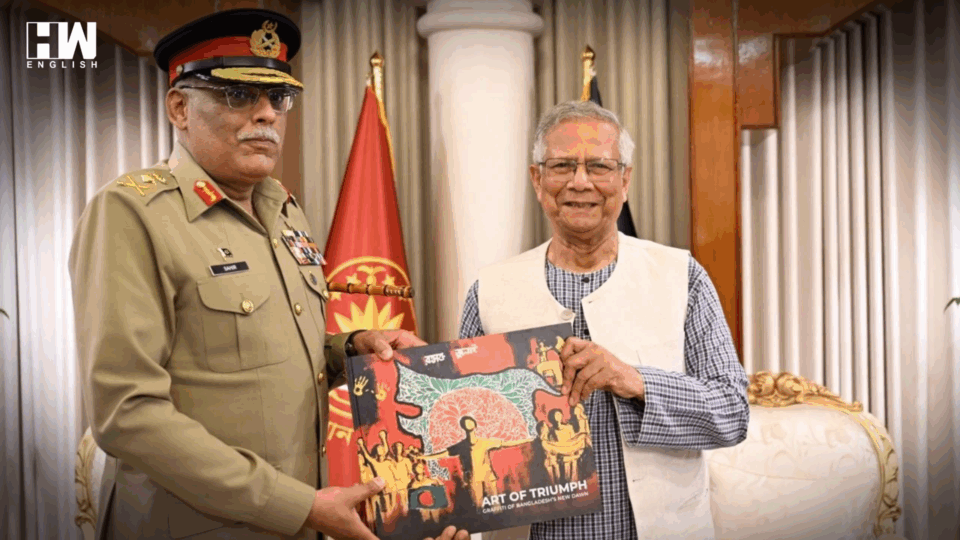
The recent visit of Pakistan’s Joint Chiefs of Staff Committee (CJCSC) Chairman, General Sahir Shamshad Mirza, to Bangladesh made headlines after Muhammad Yunus gifted him a controversial painting depicting a map of Bangladesh that included several northeastern Indian states, such as Assam.
India’s Chief of Defence Staff, General Anil Chauhan, speaking at an event hosted by the Observer Research Foundation in July, warned about the growing convergence of interests among China, Pakistan, and Bangladesh. General Chauhan noted that the economic distress in these regions has allowed outside powers to leverage their influence, thereby creating new vulnerabilities for India.
Chief advisor of Bangladesh Muhammad Yunus’ hostility towards India can also known by his scathing statements rebutting the remarks that claimed that Hindus – who are a minority in Bangladesh – are being attacked. Yunus in a podcast with senior Journalist Mehdi Hassan said, “One of the specialities of India right now is fake news. A barrage of fake news,”
The hostility of Bangladesh’s Chief Advisor, Muhammad Yunus, towards India is also evident from his scathing remarks dismissing claims that Hindus – a minority in Bangladesh – are being attacked. In a podcast with senior journalist Mehdi Hasan, Yunus said, “One of the specialities of India right now is fake news – a barrage of fake news.”
Post-Operation Sindoor and the ouster of Bangladesh’s Prime Minister Sheikh Hasina, it seems there is a concerted attempt by Pakistan to contain India on both its eastern and western borders, while India is trying to do the same with Pakistan via Afghanistan. It is surprising to see Bangladesh – which had been performing better than Pakistan – behaving like a vassal state for larger powers, relying less on its own potential to become one.
As India deepens its outreach to Kabul and Pakistan revive its ties with Dhaka, the subcontinent risks sliding into a complex indirect confrontation that could destabilize an already fragile region. Asia’s future will be defined by less cooperation and more competition and it would be interesting to observe whether nuclear-armed neighbors choose restraint over rivalry and diplomacy over dangerous military contest.
As an independent media platform, we do not take advertisements from governments and corporate houses. It is you, our readers, who have supported us on our journey to do honest and unbiased journalism. Please contribute, so that we can continue to do the same in future.
