
Right wing ideology is often misunderstood even by Right wing apologists, because it is discussed emotionally rather than examined calmly.
At its core, right wing politics emphasises nation, tradition, order, authority, and cultural continuity. It prioritises collective identity over individual plurality, stability over rapid social change, and hierarchy over fluidity. Economically, it can range from free market capitalism to state driven nationalism. Socially, it is conservative and sceptical of disruption.
Over the last decade, right wing influence has expanded across regions, though not uniformly. Today, countries governed by right leaning leadership include India, the United States, Italy, Hungary, Israel, Argentina, and Japan, among others. Roughly a quarter to a third of the world’s governments now fall into this broad category.
Countries like Saudi Arabia, Iran, Afghanistan, and Pakistan base large parts of law and governance on religion. They emphasise tradition, authority, moral policing, and restricted personal freedoms. On social parameters, they resemble what is described as right wing politics elsewhere, though expressed through theocratic or authoritarian systems rather than electoral competition.
Right wing movements historically opposed communism because it threatened property, hierarchy, religion, and nationalism. As communism declined globally, that oppositional energy did not disappear. It was redirected.
Liberalism now occupies that adversarial space because it champions pluralism, minority rights, secularism, and institutional checks on power. For modern right wing politics, liberalism represents a more immediate and pervasive challenge than communism ever did. Unlike communism, liberalism operates from within democratic systems, making the conflict cultural rather than ideological or economic.
Right wing politics thrives on conflict because identity is faster than governance. Structural reforms are slow and complex. Identity offers instant clarity. A simple “us” and a defined “them”. Conflict mobilises emotion, loyalty, and silence. Fear unites faster than reason.
Across the world, people are choosing right wing leadership not always out of ideological commitment, but out of frustration. Liberal governments often speak in nuance and process. Right wing leaders offer certainty and decisiveness. In uncertain times, clarity feels comforting, even when it is oversimplified.
This is not a moral judgement. It is a political reality. When societies feel anxious or unheard, they do not vote for complexity. They vote for control.
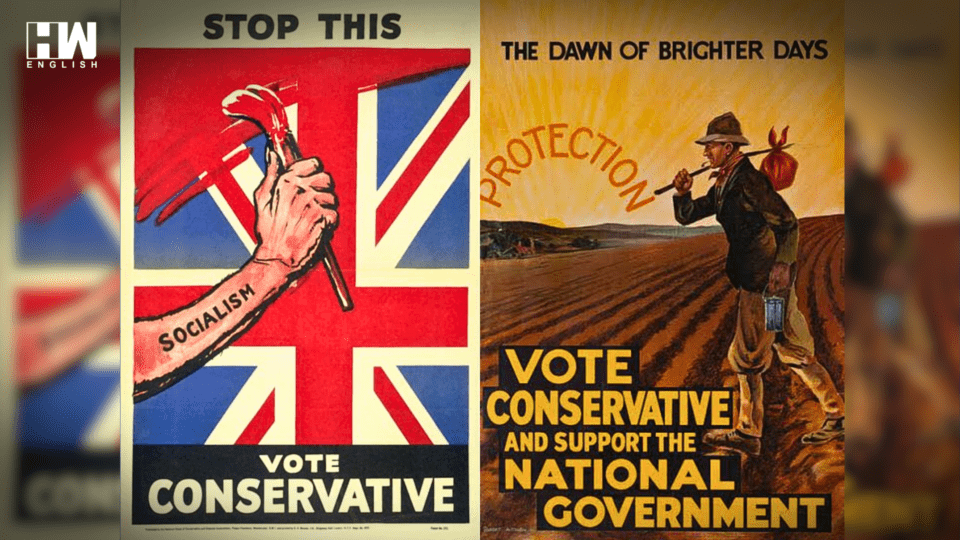
The real test of any ideology is not how powerfully it mobilises fear, but how responsibly it governs once power is secured (pic: Some Iconic Right Wing Campaign Posters from the past)
Dear Readers,
As an independent media platform, we do not take advertisements from governments and corporate houses. It is you, our readers, who have supported us on our journey to do honest and unbiased journalism. Please contribute, so that we can continue to do the same in future.
As an independent media platform, we do not take advertisements from governments and corporate houses. It is you, our readers, who have supported us on our journey to do honest and unbiased journalism. Please contribute, so that we can continue to do the same in future.
