
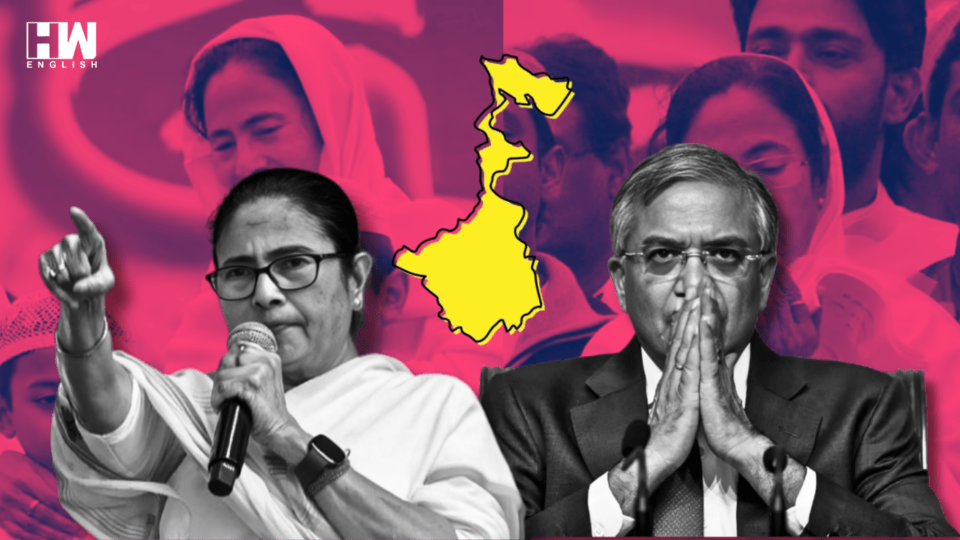
The Special Intensive Revision of electoral rolls has removed millions of names across West Bengal, sparking intense debate ahead of the 2026 Assembly elections. Significant deletions have occurred in areas with large Muslim populations, raising questions about the Trinamool Congress’s traditional support base. Yet Chief Minister Mamata Banerjee and her party stand on firmer ground than the raw numbers suggest. Close to 15 lakh names have been struck off in Muslim-concentrated districts including Murshidabad, Malda, North 24 Parganas and South 24 Parganas. Over 60 lakh more applications remain pending adjudication, the bulk concentrated in the same regions. These figures appear alarming at first glance. However, deeper structural realities, a powerful consolidation effect and the relative weakness they impose on the Bharatiya Janata Party together limit the damage to TMC. The exercise has inadvertently created a narrative of victimhood that is mobilising minority communities more effectively than routine campaigning ever could. Mamata Banerjee’s decades-long cultivation of inclusive politics now pays dividends precisely when the voter list shrinks. The deletions do not dismantle her core arithmetic; they sharpen the emotional edge that turns out her voters in higher proportions. Pending cases offer further room for corrective action through aggressive document drives. In the final analysis, the SIR may prove to be a net political gain for the ruling party rather than a setback.
Demographic Fortress Holds Firm
Murshidabad and Malda remain the undisputed heartlands of Muslim political influence in Bengal. Muslims constitute 66.27 per cent of Murshidabad’s population and 51.27 per cent of Malda’s according to the last available census. The removal of nearly 2.93 lakh names in Murshidabad and 2.20 lakh in Malda does not alter this fundamental majority status. These districts will continue to return TMC candidates with comfortable margins because the community’s relative weight inside the electorate stays decisive. Absolute losses matter less when the surviving voters form an unassailable bloc that no rival combination can match. In such territories, even a reduced headcount translates into the same seat outcomes because the opposition lacks depth to exploit the gaps. TMC booth-level workers are already converting the deletions into door-to-door grievance sessions that reinforce loyalty rather than erode it. The party’s organisational machinery, built over years of targeted welfare schemes, ensures that restored names through pending adjudication will flow disproportionately to its candidates. Demographic reality therefore acts as a natural buffer, insulating Mamata Banerjee from the full impact of the revision in her safest zones.
Consolidation Turns Anger Into Electoral Fuel
The narrative of selective deletion has produced a rare unity across minority communities that far outweighs the numerical shrinkage. Muslims, Matuas and Rajbanshis, traditionally distinct groups, now perceive a common threat to their citizenship documents and voting rights. Roughly 1.2 lakh Matua names deleted in pockets such as Dabgram-Fulbari, Bagda and Kalyani have extended the sense of injustice beyond the Muslim fold. This cross-community solidarity is manifesting in spontaneous meetings, joint verification camps and heightened emotional attachment to TMC as the only credible protector. Higher turnout among the remaining voters is the expected outcome. Historical patterns show that perceived attacks on minority identity routinely push participation rates upward by 8 to 12 percentage points in affected areas. With over 60 lakh cases pending, including 11 lakh in Murshidabad, 8.28 lakh in Malda, 5.22 lakh in South 24 Parganas and 5 lakh in North 24 Parganas, TMC’s legal and administrative teams are positioned to secure favourable resolutions before polling. Every restored name becomes a personal victory attributed to Mamata Banerjee’s intervention. The BJP, by contrast, finds itself defending the same process that has alienated its own Matua base, leaving it unable to capitalise on any Muslim-side vacuum. This consolidation dynamic effectively neutralises the deletions and may even expand TMC’s effective vote share on election day.
Swing Seats Stay Manageable, Rivals Bleed More
North 24 Parganas and South 24 Parganas present the only zones where deletions could theoretically alter local balances, with Muslim populations at 25.82 per cent and 35.57 per cent respectively. Nearly 9 lakh names removed in North 24 Parganas and 87,000 in South 24 Parganas might shift ratios in 10 to 13 mixed assembly segments. Yet even here the impact remains contained. The absolute numbers, while large, are spread across dozens of booths, and the pending adjudication pool allows TMC to target restorations precisely in the tightest contests. More crucially, the BJP cannot convert these marginal demographic shifts into gains because its own Matua losses in the same districts have created a deeper crisis of confidence among the very refugee voters it needs for breakthroughs. The party’s limited presence in Muslim belts prevents any compensatory advance. Mamata Banerjee’s strategy of framing the entire SIR as an assault on Bengal’s secular fabric further unifies the 30-35 per cent minority slice in these areas, ensuring that surviving voters turn out en masse. Seat-wise projections therefore show TMC losing at most a handful of marginal constituencies while retaining the overwhelming majority through heightened loyalty. The net arithmetic continues to favour the ruling party.
The SIR has thus produced an ironic outcome. What began as an administrative cleansing exercise has strengthened the very political ecosystem it appeared to challenge. Mamata Banerjee retains her core bastions through unbreakable demographic realities, gains motivational energy through community consolidation and faces only limited pressure in swing zones where her rivals suffer parallel setbacks. The 60 lakh pending cases provide a final safety valve that TMC is best equipped to operate.
As the 2026 campaign intensifies, the deletions of Muslim names will be remembered less as a blow to the Trinamool Congress and more as the catalyst that forged an unbeatable minority front behind Mamata Banerjee. The ruling party enters the election cycle not weakened but paradoxically fortified by the very process designed to scrutinise the rolls.
(Sayantan Ghosh is a columnist and the author of two books: Battleground Bengal, published by the Penguin Random House, and The Aam Aadmi Party, published by the Juggernaut. He is on X as @sayantan_gh.)
As an independent media platform, we do not take advertisements from governments and corporate houses. It is you, our readers, who have supported us on our journey to do honest and unbiased journalism. Please contribute, so that we can continue to do the same in future.
