
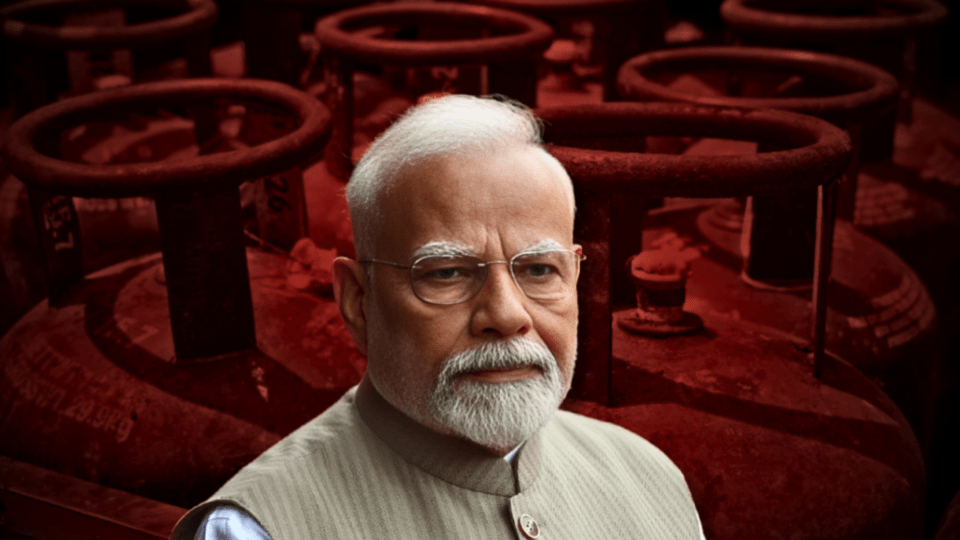
Why is a country that sends missions to the Moon suddenly struggling to supply cooking gas to its own people?
Over the last few days, reports of LPG shortages have started emerging from several Indian cities. Restaurants are warning of shutdowns. Commercial users are scrambling for cylinders. And many households are wondering whether their next refill will arrive on time.
The immediate trigger lies thousands of kilometres away. The escalating tensions and military conflict in West Asia have disrupted energy supply chains passing through the Strait of Hormuz. A very large portion of the world’s oil and LPG shipments move through this narrow waterway. When instability rises there, the ripple effects are felt across Asia.
India is particularly vulnerable.
Today India imports roughly sixty percent of the LPG it consumes. An overwhelming share of that supply comes from the Gulf region. The moment shipping routes become uncertain or cargoes get delayed, the supply chain inside India starts tightening.
But the deeper problem is structural.
Over the last decade, the government rightly expanded LPG access to millions of households through schemes like the Pradhan Mantri Ujjwala Yojana. This dramatically increased demand. However, the expansion of domestic production, strategic reserves and diversified import sources did not keep pace with the surge in consumption.
India built strategic reserves for crude oil. But it never created a meaningful buffer stock for LPG.
Energy planners have also known for decades that the Strait of Hormuz is one of the world’s most sensitive geopolitical chokepoints. Yet India’s dependence on that route remained extremely high.
To be fair, the government is now taking emergency steps. Refineries have been asked to maximise LPG production and supplies are being prioritised for households over commercial users.
Crises like this highlight a larger truth. Expanding access to energy is only half the job. Securing the supply chain is the other half.
As an independent media platform, we do not take advertisements from governments and corporate houses. It is you, our readers, who have supported us on our journey to do honest and unbiased journalism. Please contribute, so that we can continue to do the same in future.
