
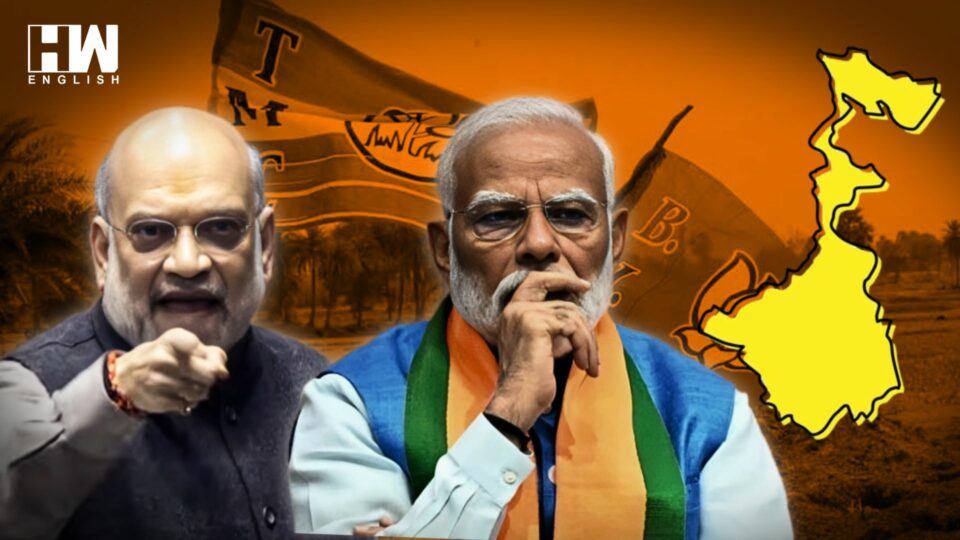
BJP’s struggles run deeper. Over-reliant on Prime Minister Narendra Modi and Home Minister Amit Shah, the party has neglected local cultivation
In the political landscape of West Bengal, where regional identity and grassroots resilience define electoral success, the Bharatiya Janata Party (BJP) has repeatedly faltered in its bid to challenge the dominance of Mamata Banerjee and her Trinamool Congress (TMC). Despite aggressive campaigns, substantial vote shares in national elections, and leveraging national narratives, the BJP’s inability to translate momentum into state-level dominance underscores a deeper malaise.
This weakness is not merely tactical—arising from short-term missteps or campaign errors—but profoundly structural, embedded in the party’s organizational DNA and its mismatch with Bengal’s unique socio-political fabric.
West Bengal’s politics has long been shaped by a blend of leftist legacies, cultural pride, and economic grievances, where leaders like Banerjee embody a street-fighter ethos that resonates with the masses. Her third consecutive term as Chief Minister, solidified in the 2021 assembly elections with a commanding majority, defied predictions of a BJP surge. Even in the 2024 Lok Sabha polls, while the BJP secured 12 seats, its vote share hovered around 38%, failing to erode TMC’s stronghold amid anti-incumbency sentiments over issues like unemployment and corruption scandals.
Analysts point to Banerjee’s welfare schemes, such as cash transfers targeting women and minorities, which bolstered her support base, yielding her party 48% of the vote in 2021.
Yet, the BJP’s struggles run deeper. Over-reliant on central figures like Prime Minister Narendra Modi and Home Minister Amit Shah, the party has neglected local cultivation. Internal divisions, a lack of a relatable Bengali face, and the ineffectiveness of religious polarization in a state prizing secular harmony and linguistic identity have compounded this.
These structural flaws explain why, despite years of investment, the BJP remains on the periphery, unable to convert national appeal into regional hegemony. As Bengal approaches the 2026 assembly elections, these issues highlight a party ill-equipped to counter Banerjee’s enduring grip on the state’s imagination.
Over-Dependence on Central Leadership and Agencies
The BJP’s strategy in West Bengal has been heavily anchored in Delhi’s orbit, relying on high-profile interventions from Narendra Modi and Amit Shah rather than building a self-sustaining local apparatus. This top-down approach manifests in major campaigns led by central figures, who often address rallies in Hindi, alienating rural voters where Bengali is the lingua franca and comprehension of national languages is limited.
In the 2021 elections, Modi’s extensive rallies failed to bridge this linguistic divide, contributing to the party’s shortfall despite a vote share increase from 10% in 2016 to 38%. Shah’s visits, including chairing meetings to resolve internal disputes, underscore the party’s inability to function autonomously.
This dependence extends to central agencies like the Enforcement Directorate (ED) and Central Bureau of Investigation (CBI), weaponized against TMC leaders on corruption charges. Raids and arrests, such as those in high-profile scams, aimed to tarnish Banerjee’s image but often backfired, portraying the BJP as vindictive outsiders meddling in state affairs.
Moreover, the strategy lacks coherence: the BJP oscillates between attacking corruption, illegal immigration from Bangladesh, minority appeasement, and unemployment without a singular focus. This scattershot narrative confuses voters, diluting the party’s message amid Banerjee’s targeted welfare rebuttals. In 2024, despite anti-incumbency over joblessness, the BJP’s mixed messaging allowed TMC to frame it as opportunistic, preventing consolidation of discontented votes.
Structurally, this over-reliance stifles local initiative. Without empowering Bengal-based leaders to craft region-specific policies, the party remains detached from ground realities like agrarian distress and cultural sensitivities. As Shah’s 2025 interventions to streamline election planning reveal, Delhi’s micromanagement highlights a void in organic growth, perpetuating the BJP’s image as an imposed force rather than a homegrown alternative. This not only hampers voter connect but also exposes the party’s vulnerability when national leaders are stretched thin across states.
Deep Internal Factionalism
Internal divisions within the Bengal BJP have eroded its cohesion, turning potential strengths into debilitating weaknesses. Factionalism, evident in rival camps led by figures like current state president Somik Bhattacharya, Leader of Opposition Suvendu Adhikari, former state president Sukanta Majumdar (now a Union Minister), and veteran Dilip Ghosh, has necessitated interventions from central leaders.
In 2025, Shah chaired meetings to mediate disputes, even recalling Ghosh—who had been sidelined—to bolster election planning, signaling the severity of the rift. These camps rarely collaborate; joint rallies are scarce without Delhi’s oversight, fragmenting campaign efforts.
This infighting stems from power struggles post-2021, where the party’s assembly seats rose to 77 but fell short of victory. Blame games ensued, with leaders accusing each other of sabotage. In 2024, post-Lok Sabha setbacks, Ghosh publicly questioned the organization’s credibility, while incidents like the heckling of district chiefs underscored grassroots unrest. The Rashtriya Swayamsevak Sangh (RSS), the BJP’s ideological parent, intervened in 2025 to heal rifts, but tensions persist, as seen in exclusions from the 2026 state committee, including Bhattacharya, Ghosh, Majumdar, and Adhikari.
Such discord hampers booth-level operations, crucial in Bengal’s volatile politics. Unlike TMC’s unified command under Banerjee, the BJP’s factions prioritize personal ambitions over collective strategy, leading to defections and weakened mobilization. In 2025, a district chief was attacked by party members, prompting suspensions, yet this only amplified perceptions of disarray. Structurally, this reflects the party’s rapid expansion without ideological consolidation, importing TMC defectors who bring old rivalries. As the 2026 polls loom, unresolved factionalism risks further electoral erosion, allowing Banerjee to exploit the BJP’s “divided ranks” narrative.
Absence of a Credible Bengali Leadership Face
The BJP’s faceless front in Bengal—lacking a charismatic, locally rooted leader to rival Banerjee—remains a glaring structural deficit. Unlike Banerjee, who embodies Bengali resilience with her grassroots origins and vernacular appeal, the BJP’s state figures like Adhikari and Majumdar lack widespread charisma or unifying presence. Adhikari, a TMC defector, carries baggage from past affiliations, while Majumdar’s ministerial role ties him more to Delhi than local concerns.
This vacuum was stark in 2021, when the party projected no clear chief ministerial candidate, relying instead on Modi’s national stature. Post-election analyses highlighted the lack of an “acceptable face” against Banerjee as a key failure, preventing voter consolidation. Ghosh, once a prominent voice, was marginalized, exacerbating the leadership crisis. Efforts to induct defectors for star power backfired, as many lacked genuine support bases, leading to perceptions of opportunism.
Bengal’s voters prioritize leaders attuned to regional pride, language, and culture—elements the BJP’s Hindi-speaking central cadre overlook. This disconnect fuels discontent, with rural populations viewing the party as culturally insensitive. Without a credible Bengali face, the BJP struggles to build trust, especially among moderate Hindus and secular voters who see Banerjee as a defender of state identity.
Structurally, this stems from inadequate investment in nurturing local talent, favoring imports over organic growth. As 2025 membership drives faltered despite incentives, the party’s inability to attract active grassroots leaders persists. This leadership void not only hampers narrative control but also reinforces Banerjee’s dominance as the unchallenged “Didi” of Bengal.
Failure of Religious Polarization
In a state where secular traditions, linguistic pride, and syncretic culture overshadow communal divides, the BJP’s Hindutva agenda has repeatedly faltered. Bengal’s significant Muslim population (30%) and moderate Hindu voters resist polarization, viewing it as alien to the state’s identity rooted in Tagore’s humanism and Durga Puja’s inclusive ethos. The 2021 elections saw the BJP’s attempts at communal rhetoric—focusing on “appeasement” and immigration—yield limited gains, as TMC countered with welfare transcending religious lines.
Efforts to stoke Hindu nationalism, such as temple visits and anti-infiltration drives, backfired amid perceptions of cultural imposition. In 2025, Ghosh’s Jagannath temple visit sparked internal discord, highlighting how such tactics divide even within the party. Bengal’s history of leftist secularism and regional pride prioritizes issues like employment and identity over religious fault lines, rendering Hindutva ineffective.
From aggressive Ram Navami celebrations to incendiary communal statements, and from branding Bengali Muslims as Rohingyas or Bangladeshis to invoking fears around CAA–NRC and the Special Intensive Revision of electoral rolls, the BJP has attempted to consolidate Hindu voters through polarisation. However, the strategy has largely backfired. Instead of uniting Hindus, it has led to counter-polarization: Muslim voters have become more consolidated, while moderate and secular Hindus—uncomfortable with such aggressive identity politics—have increasingly distanced themselves from the BJP.
This failure is structural: the BJP’s national model clashes with Bengal’s demographics, where Muslims and secular Hindus form a bulwark against division. In 2024, amid economic woes, voters rebuffed polarization, favoring Banerjee’s inclusive appeals. As regional pride trumps communalism, the party must rethink its playbook, but entrenched ideology limits adaptation, perpetuating its marginal status.
Sayantan Ghosh is an academic and the author of ‘The Aam Aadmi Party: The Untold Story of a Political Uprising and Its Undoing’. He is on X as @sayantan_gh. Views expressed are personal.
As an independent media platform, we do not take advertisements from governments and corporate houses. It is you, our readers, who have supported us on our journey to do honest and unbiased journalism. Please contribute, so that we can continue to do the same in future.
