
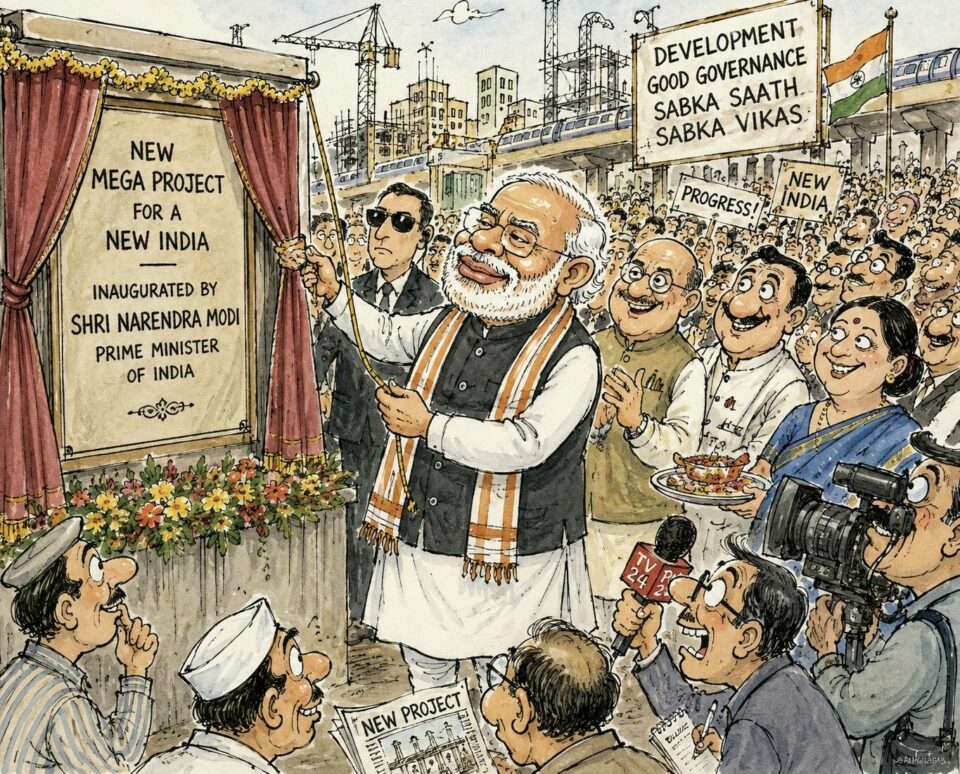
Over the last decade, India has witnessed some of the most ambitious national campaigns ever launched by any government. Many were driven by good intentions. Many generated genuine public enthusiasm. Many captured the public imagination.
But enthusiasm and execution are not the same thing.
Take Swachh Bharat.
Who can forget the images? Politicians, officials, celebrities and corporate leaders holding brooms, sweeping roads while television cameras rolled. The campaign became a national movement. It generated awareness on a scale India had rarely seen before.
But awareness is only the first step.
The real challenge was building a culture of civic discipline, efficient municipal systems, waste segregation, scientific disposal and accountability. Those are not achieved through photo opportunities. They require sustained administration.
The same pattern is visible even today.
The Prime Minister recently appealed to citizens to reduce fuel consumption and help the nation save valuable foreign exchange. It is a sensible objective. Soon after, ministers and public figures were photographed riding bicycles, scooters and motorcycles.
Yet, by evening, many return to the comfort of large convoys and official entourages. The symbolism remains. The underlying problem remains too.
Reducing a nation’s fuel bill is not achieved through a day’s symbolism. It requires better public transport, improved urban planning, efficient logistics, stronger rail networks, cleaner energy alternatives and policies that make fuel efficient choices practical for millions of citizens every day.
Otherwise, a serious economic challenge risks becoming another public relations exercise. The photographs are remembered. The structural problem remains.
Consider initiatives such as Make in India, Startup India and Digital India. These campaigns created visibility, attracted attention and helped shape a national conversation around manufacturing, entrepreneurship and technology.
That is valuable.
But the success of such initiatives ultimately depends not on logos, slogans or launch events. It depends on ease of doing business, access to capital, regulatory consistency, infrastructure, institutional capacity and administrative efficiency.
The difference between branding and execution is the difference between a promise and a result.
Major policy interventions reveal the same challenge.
Take GST.
The idea itself was sound and widely supported. Yet its rollout was marked by compliance burdens, technical glitches and repeated rule changes.
Demonetisation offered a different lesson. The debate was not just about implementation, but also about whether the policy itself could achieve its stated objectives.
In governance, outcomes matter more than optics.
That, perhaps, is the central governance challenge facing India today. We have become exceptionally good at announcing initiatives, launching campaigns and creating powerful narratives. We are less successful at building institutions that quietly deliver measurable outcomes year after year.
Governments win headlines through symbolism.Nations progress through execution. The true measure of governance is not what happens in front of the camera.
It is what continues to happen long after the camera has moved on.
As an independent media platform, we do not take advertisements from governments and corporate houses. It is you, our readers, who have supported us on our journey to do honest and unbiased journalism. Please contribute, so that we can continue to do the same in future.
